Showing posts with label lobbying. Show all posts

Monday, August 3, 2009

Dear Congress, Climate Regulations Hurt Minorities. Love, "NAACP."

Only days after I wrote about the power of special interest lobbies in Congress versus the power of the American people as a whole, an interesting story broke. According to the Times:
A grass-roots lobbying firm has acknowledged forging letters opposed to the climate bill that were sent to a Virginia lawmaker. The office of Representative Tom Perriello discovered that a half-dozen letters it received had nearly identical language signed by a made-up person at Creciendo Juntos, a Latino group, and five fake members of the Albemarle-Charlottesville branch of the N.A.A.C.P.
So here we have the powerful, corporation-financed professional lobbyists—who already have a great deal of clout among Congress members and often win victories for companies whose actions are harmful to the public good—posing as members of nonprofit organizations that seek to give a voice to historically voiceless or powerless communities, in order to block legislation that would disadvantage their clients.

The bill claimed that the American Clean Energy and Security Act (ACES) would be deleterious to low-income families (the opposite is in fact true, according to the Congressional Budget Office). And here's the best part:
The lobbying firm, Bonner & Associates, apologized to the groups and attributed the faked letters to a temporary employee who, it says, has been fired.
Well, problem solved, then, Bonner & Associates. Glad that meddlesome rabble-rouser is out of there! Shame they weren't able to catch him before the bill went to a vote.

How often does this happen when the perpetrators aren't caught? And how often do forged letters like these end up influencing Congressional votes? ACES only narrowly passed the House, and more moderate Congress members could have easily been swayed by a completely fabricated plea allegedly coming from important advocacy groups.

Even with a political system that is already tainted by unethical injections of money, greed, and power, those with the advantage still don't play fair. How can the public be served when the public seems to be neglected or undermined at every turn?

Friday, June 26, 2009

Climate Bill Passes by an All-Too-Thin Margin

The U.S. House of Representatives just passed the American Clean Energy and Security Act of 2009 by a margin of seven votes, 219 to 212. Kudos to Chairmen Waxman and Markey for taking the lead on the most crucial issue of the next several generations, the threat of global climate change. Many perceive the issue as an environmental one, and one that is only a victory for "environmentalists." But that couldn't be further from the truth.

As I have touched on many times, climate change is an all-encompassing issue that threatens a seemingly endless variety of other issues. You might personally believe that healthcare, civil liberties, war, or any number of other issues is a bigger priority than climate change, a supposedly futuristic notion predicated upon shaky science. But every issue being debated in the United States today can in some way be connected to climate change—or at least related policies.

Tom Friedman wrote in Tuesday's Times that weaning ourselves off of oil could serve to undermine oppressive oil-rich regimes in countries like Iran, Saudi Arabia, and Russia. Many countries rich from oil use their profits to invest in nuclear weapons or fund terrorism. Anyone care to do something about nukes and terrorists? Isn't that why we're in Iraq and Afghanistan (or at least Afghanistan)? Isn't that why we're so frightened of Iran?

If we don't address climate change, the healthcare issue will only be exacerbated. Airborne diseases will increase with increased temperatures, including potential epidemics for which we are ill prepared.

If we don't address climate change, refugees of floods, droughts, and desertified lands will try to flee to other countries to rebuild their lives, and as we see all over Africa and Asia, an increase in ethnically diverse populations in economically depressed regions competing for the same jobs and resources tends to lead to intrastate conflict that can easily spread across borders. Want to help prevent war? Help prevent climate change.

Even the agricultural community in the United States, who lobbied hard enough to essentially fend off any potential regulation of greenhouse gas emissions in the agricultural sector, would be drastically affected by even a minor change in temperature and climate conditions. But the major problem here is that no one thinks in the long term.

And that is exactly why Republicans, only eight of whom voted for the legislation today, are able to exploit it for political gains. 'It only amounts to a tax,' they say. 'It will only hurt American business and force consumers to pay more for their heat, power, and gasoline.' For them, it's not about preventing disaster across the world. It's about winning back a Republican majority in the United States Congress by exploiting myopic concerns. But climate change is not just an environmental issue, and it's sure not a partisan issue. It has somehow devolved into both over the course of the debate on regulation, and will inevitably cause forward-thinking politicians to lose their seats. This is the unfortunate reality in a democracy like ours of standing up for what is right, even if it may not be exceptionally popular in the short run.

So the Waxman-Markey bill, even though it was watered down excessively to cater to wealthy businesses and utilities and power-wielding lobbyists, has finally passed. No one knows if it will accomplish anything near what scientists say we need to. But at least it's a start. And now the issue will move on to the Senate, where it will be diluted even more, and progress will only be hindered further. In 40 years, we'll all look back at this and wonder how we could have been so ignorant. Those who opposed the bill are on the wrong side of history, just as the anti-civil rights folks were in the '50s and '60s. But in the realm of climate change, by the time that fact is universally accepted, it could very well be too late.

Images: Climate rally outside Capitol (Wall Street Journal), Ahmadinejad in front of oil refinery (New York Times), Republican opponents to ACES (TreeHugger)

Saturday, June 20, 2009

Ag Committee/Lobby Stymies Climate Regulations

H.R. 2454, the American Clean Energy and Security Act, finally passed through the Energy and Commerce Committee of the House a few weeks ago, after weeks and weeks of tough negotiations, and lots of unfortunate compromises that will only serve to further slow the process of cutting carbon emissions in the United States. Henry Waxman and Ed Markey, the crafters of the original bill, have since been meeting with lawmakers in the House, explaining to them the functions of various components of the bill, as well as the "safety valves" encouraged by more conservative Democrats like Rick Boucher, who have also recently been promoting the merits of the bill to Congress.

Now, with Speaker Pelosi interested in calling the bill to a floor vote possibly within a week, one great obstacle has stood in the way of passage: the House Agriculture Committee. The chair of the committee, Collin Peterson, a Democrat who represents all of western Minnesota, has remained stubbornly opposed to the bill's passage, not because it directly impacts farmers, but because it doesn't benefit them enough. Peterson wants to be able to enhance the ability for farmers and agrobusinesses to reap the benefits of biofuels such as corn ethanol, as well as give them more opportunities to sell carbon offsets to other polluters.

The ag business community is most fervently opposed to the Environmental Protection Agency (EPA) having any role in compelling them to monitor their greenhouse gas emissions, and Peterson actually sponsored an amendment to cut off funding for the EPA's analysis into whether corn ethanol actually has such a great deal of indirect carbon emissions associated with its life cycle that it is in some ways more harmful than gasoline. Cutting of funds for a scientific analysis—now there's a useful way to get your agenda across.

And Peterson's committee is certainly not the only one that's helping to squander our best chance to address climate change. The House Appropriations Committeee just approved an interior appropriations bill establishing the EPA's budget for fiscal year 2010, but incorporated two amendments wherein 1) the agency is not allowed to tell farmers to even report their emissions, and 2) all livestock operations are exempt from possible future climate regulations. The ag lobby seems to have Congress right where they want them.

The worst part is this quote by Rep. Peterson:
My problem this year is it's been so cold that the crops aren't coming up. And they're saying to us, 'Oh, it's such a big problem because it's going to be warmer than it usually is.' My farmers are going to say that's a good thing—we're going to be able to grow more corn.
Well, while south Asian countries are being flooded, Pacific islands are submerging, desertification is rendering African farmland unusable, ice caps are melting, weather conditions are becoming more erratic, and millennia-old ecosystems are being quickly destroyed, at least Minnesota farmers might have a few good harvests.

Images: Collin Peterson (umn.edu), ag lobby cartoon (greenscissors.com), corn field (Climate Chnage Connection)

Tuesday, December 9, 2008

Something Is Rotten in the State of Illinois

Today, Democratic Illinois Governor Rod Blagojevich was arrested by the FBI on corruption charges. The Bureau had been bugging his phones for weeks, listening in on conversations that revealed, among other illegal conspiracies, his plans to try to “sell” Obama’s Senate seat. “If I don’t get what I want and I’m not satisfied with it, then I’ll just take the Senate seat myself,” he was recorded saying. The practice of having the governor select a candidate to fill a Senate vacancy, which many states subscribe to, is inherently a sketchy one. I can understand the desire to circumvent a costly campaign and election whenever a Senator leaves office, and in most cases, a special election is held during the next Senate election cycle, regardless of how long the Senator had served, à la Joe Biden’s seat.

Indeed, Ruth Ann Minner of Delaware went through the same sorts of deliberations, and David Paterson of New York is in the process of choosing Hillary Clinton’s replacement—both are choices that have political implications and can be met with a great deal of opportunistic strategy. But Blagojevich’s arrest raises far more meaningful questions than those about Senatorial politics. The 74-page criminal complaint against the Governor describes a slew of crimes he committed. Here are some highlights:
  • Trading government jobs and contracts for contributions to his campaign fund. For example, he allegedly said he would hold up $8 million in financing to the Children’s Memorial Hospital unless he got a $50,000 contribution from its chief executive officer.
  • Negotiating with the Tribune Company, which owns both the Chicago Tribune and the Chicago Cubs, to fire one of the governor’s critics on the Tribune’s editorial board in exchange for state financing of the sale of Wrigley Field
  • Envisioning ways to take advantage to the greatest extent possible of the open Senate seat, including:
  • Convincing Obama to ask Warren Buffet to give $10-$15 million to a foundation that Blagojevich would later head
  • Appointing himself, in order to avoid impeachment, facilitate his wife’s career as a lobbyist, pave the way for a 2016 run for the presidency, and/or increase his speech fees once he retires from politics.

Blagojevich already had the lowest approval ratings of any governor in the country due to previous charges of corruption. Illinois, and Chicago in particular, is a notoriously corrupt state. But it is exactly this type of appalling situation that should force legislators to sit down and write more stringent ethics, campaign finance, and lobbying laws. Our country’s politicians are, with few exceptions, immersed in special interests. Lobbyists with money have exponentially more political influence than ordinary citizens without money, and campaign contributors, especially in Blagojevich’s case, have exceptional influence as well (or at least those who want any influence must become campaign contributors).

Congress is obviously reticent to enact sweeping ethics bills, because, well, they’d essentially be restricting their own behavior. Campaign finance laws are especially weak, thanks in part to recent Supreme Court decisions that have ruled against stricter regulations under the guise of “First Amendment protection.” While I was disappointed to see Obama renege on his vow to accept public financing, it was clearly the right decision for his campaign to make, as there were few obstacles precluding McCain’s campaign from effectively using the much less restricted donations piling into the Republican National Committee's chest.

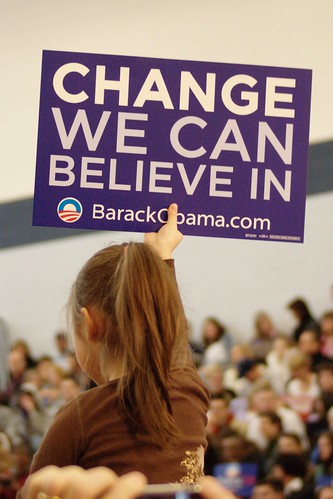
Barack Obama spent a lot of time on the campaign trail talking about lobbying and campaign finance reform, especially in the primaries (which, in my opinion, was part of both his and John Edwards’s appeal). And perhaps with the current economic crisis, such issues will be pushed to the backburner, as they are not entirely urgent. But Rod Blagojevich’s arrest should be a reminder to the country that we need to be addressing ethics in politics much more forcefully. A large part of the reason we’re so far behind on healthcare, climate change, energy independence, and now most evidently banking and financial regulation, is the potency of lobbyists over the hopes and needs of the true constituents in a democracy—the people. Only when a poor, ailing woman with no health insurance has as strong a voice in government as a bigwig insurance agency lobbyist can we truly say we are a democracy.

There is so much cynicism toward politics in our country, and with good reason. From Ted Stevens to William Jefferson to Rod Blagojevich, there seems to be little reason to trust those who are supposed to be working on our behalf. That all needs to change. And hopefully the one who’s been promising that change for two years will be able to deliver. But the proof will be in the pudding.

Photos: Rod Blagojevich (Washington Blade), Capitol for sale (CleanUpWashington.org), Obama and Clinton during a primary debate (Newsday.com), Change we can believe in (Flickr.com)