The Massachusetts Senate Election
 On Tuesday, Massachusetts voters elected the little-known Scott Brown to assume the late Ted Kennedy's seat. Kennedy spent decades fighting tooth and nail for health care reform, and now reform is severely threatened by Brown's impending inauguration. He has already vowed to obstruct the Democrats from passing a bill (nothing new for a Republican), and now Democrats are starting to back off any ambition they once had for making the bill strong and thorough. Massachusetts voters, who had been enamored of Ted Kennedy for decades, voted to betray his dying wish. I am not saying that the successor to his seat should have espoused his every view; I am saying that whatever values Ted Kennedy held that Massachusetts citizens ostensibly held in such high esteem for so long, they instantaneously turned their backs on.
There are innumerable factors that likely lifted Brown to victory, most of which have been discussed at length. Coakley ran an awful campaign. Voters were still disillusioned by the nation's employment and housing crises. The election was taken for granted by Democrats for too long. But whatever the reason for the shocking defeat, there are now 41 Republicans in the Senate, opening the possibility of interminable filibusters and continued obstruction until November, when Republicans will point out to Americans that Democrats have accomplished next to nothing, despite holding the Presidency and both Houses of Congress by sizable majorities.
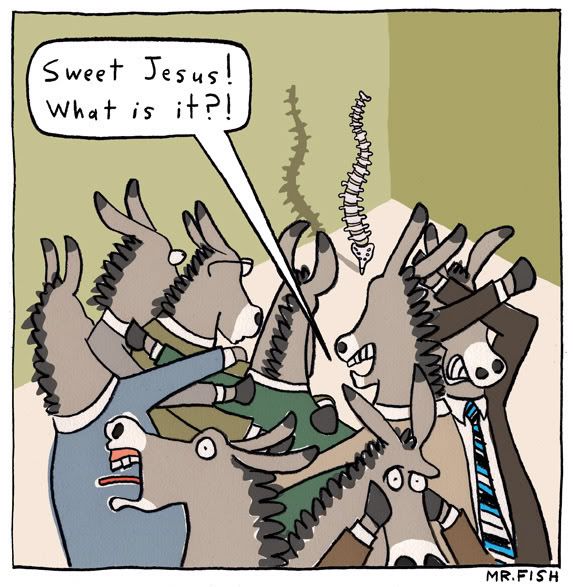 The House climate bill can be completely scrapped. (Why do we even have a House, by the way? Sure, they're much more representative of our country than the Senate, but who needs representatives, when they don't seem to have a say in anything?) The relatively progressive House health care bill will likely give way entirely to the Senate health care bill so that at least something is passed (if there's no health care bill passed at all this year, Democrats can probably say goodbye to legislative chamber majorities come November). Who knows if there will be a jobs bill (even though that's what people are most concerned about right now). Financial regulations will pass, but likely in a weak bill that will maintain much of the status quo for the very sharks who helped push the world economy into a deep recession.
What exactly were Massachusetts voters voting for, then? Were they trying to send a message that they're mad? Because like it or not, Scott Brown will not get back at Wall Street. Scott Brown will not help create short-term jobs (his solution is to cut taxes). And by the way, when you're out of a job, Scott Brown certainly won't help you get health insurance. Oh, unless you're from Massachusetts, where progressive Democrats already passed legislation to ensure that for you. Ted Kennedy's dream, and life's work, which was so close to fruition, has been betrayed by his own loving constituents, solely because of his death. The irony is excruciating.
The U.S. Supreme Court Decision
 In other horrible elections news, today the Supreme Court ruled that the government can't ban political spending by corporations in candidate elections. I've talked at length about this issue before. While I have problems with the inherent idea of democracy (see: Massachusetts voters voting against their own interests and the interests of their country), I still acknowledge that it is the only form of government that reflects the ideals of human freedom, justice, and equality. It has its flaws, of course, and must be periodically improved so that these core tenets are not betrayed. Today, they were betrayed.
The four conservative ideologues on the Supreme Court and one alleged (but woefully misguided) moderate have further opened the election process to unprecedented levels of cash injections from big businesses, arguing that they are defending the first amendment's guarantee of freedom of speech.
Let me first say that money is not speech, and conflating those two concepts is nefariously deceptive. But we have to remember here that the Constitution has been bent, twisted, and adulterated incessantly over the past 200+ years, to behoove whomever was "interpreting" its words. In this case, conservative judges who maintain Republican allegiances and were all appointed by Republican presidents, ruled against a bipartisan law that was designed to make elections fair and unbiased, untainted by the influx of money from self-interested groups corporations.
 What is democracy now? Does the prefix demo- not mean "people"? What the majority of the Court failed to acknowledge was the underlying foundation of our democratic republic: the right of the people to choose their leaders, and the right for any person to have a chance to become one of those leaders, assuming they can compel the electorate to afford them enough votes. Now corporations will hold undue influence in all federal elections, the wealthiest of them having the biggest say in which politicians will be elected (think: Walmarts who exploit employees, Exxon Mobils and Southern Companies who unabashedly contribute to climate change, Pfizers and Aetnas who exploit the sick for massive profits, and Citigroups who get away with inciting economic turmoil and run away with unfathomable bonuses).
Whatever politicians who are still around that you thought were truly serving the interests of their constituents--that average "Joe the Plummer" that Republicans just love evoking--will soon be a vestige of a previous era of American politics. Don't get me wrong: Democrats are often just as guilty as Republicans when it comes to being beholden to special interests. And elected progressive Democrats who want to reform our election system to make it fair and democratic will soon be few and far between. Unbridled capitalism has commandeered our democracy. Our election system, the basis of American idealism, is truly tarnished in an irrevocable way (unless today's atrocious ruling is one day revoked).
It's been a really bad week for America.
Images: Scott Brown (New York Times), spineless Democrats (photobucket.com), Supreme Court Justices (Zimbio.com), Guy with sign (scu.edu)