Showing posts with label energy independence. Show all posts

Wednesday, March 30, 2011

Obama Plans to Wean U.S. Off Foreign Oil... Just Like the Seven Presidents Before Him

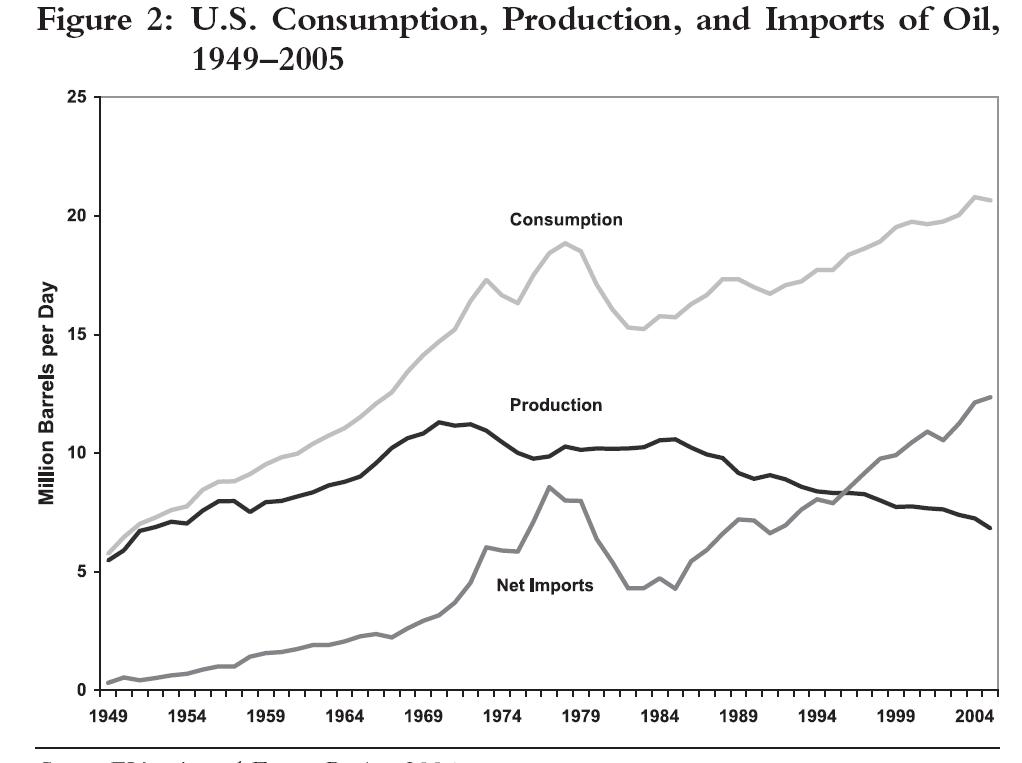
No one has summed it up better than Jon Stewart did last year: since Nixon, every U.S. president, Democrat and Republican, has bemoaned our dangerous addiction to foreign oil. And yet, U.S. oil imports have increased nearly constantly since 1949, with the exception of a drop in the late 70s and early 80s when the oil crises of the 70s forced Americans to get serious about conservation and efficiency. Now the U.S. imports more than 11 million barrels of oil each day. Almost two-thirds of our oil comes from imports, and half of that comes from unstable or unfriendly countries.

Source: Council on Foreign Relations


Today, President Obama reiterated his wish to cut oil imports by one-third in a decade. His proposed strategy:
  1. Finding and producing more oil within our borders.
  2. Reducing overall dependence with alternative fuels and efficiency.
Step 1 is what Republicans want to focus on (Drill Baby Drill!); Step 2 is what Democrats want to focus on. But even with such a bipartisan strategy, nothing is being done, just as nothing has been to seriously reduce our oil imports.

The reality is, exploring for and producing more oil at home is not a long term fix. The same arguments were brought up during the 2008 campaign when Sen. McCain and others called for expansion of domestic drilling, ostensibly as relief from high summer gasoline prices, and again by Obama last year when he announced his expanded offshore drilling proposal (less than a month before the BP spill). All this despite experts agreeing that new drilling wouldn't cut gasoline prices more than a few cents per gallon—decades later.

And a decrease in oil prices will only lead to an increase in gasoline consumption, which will create a need for more immediate oil resources, which will lead to an increase in oil imports—right back where we started. (Keep in mind that the U.S. has 2% of the world's oil reserves and consumes over 25% of the world's oil.)

What is really going to help us reach oil independence is Step 2.

Advances in alternative fuel vehicles, as well as electric, plug-in, and hybrid electric vehicles are important, and are slowly beginning to penetrate the market. Increasing fuel economy is important too, and the Obama Administration has taken some of the greatest strides in decades to increase the efficiency of American cars (to the chagrin of many Republicans).

But while more efficient cars will certainly decrease the amount of gasoline per mile traveled, they will probably not lead to the deep fuel savings that will be necessary to wean us off foreign oil. That may just need to come from conservation, in the form of less driving and more walking, biking, and public transit.

Jimmy Carter's famous conservation
talk. Source: treehugger.com

Obama hasn't mentioned conservation as part of his strategy for oil reduction, likely because it's not in the "American spirit" to have to sacrifice anything. It's political suicide to campaign for increased gas taxes—despite the myriad benefits—and the harsh criticism Jimmy Carter received for wearing a sweater in the Oval Office and asking Americans to start saving energy is still ringing in most politicians' ears.

In the 112th Congress, Obama has no hope to pass any legislation that will reduce American oil consumption. The only bills he will be able to sign will attempt to expand domestic oil production, a boon to oil companies, but far from a solution to our oil dependence (not to mention an increased risk for catastrophic impacts on the environment, the most grave example of which, after less than a year, many Americans already seem to have forgotten).

President Obama may find it an opportune time to repeat the calls for oil independence as unrest in the Middle East continues to spread and reportedly affect world oil prices. But for serious change to occur, serious measures will need to be taken, measures which the President will surely not be willing to take until at least 2013 (if he is reelected) and which the current Congress will never enact.

Sunday, May 30, 2010

Glass Half Full: Big Disasters Can Spur Big Changes

On Thursday President Obama held a press conference in which he took full responsibility for the federal government's response to the oil spill in the Gulf of Mexico. This was largely in response to widespread criticism that the White House has done little in the month since the disaster took place. Some have even gone so far as to call it "Obama's Katrina," in reference to the Bush Administration's monumental failure to provide support to the victims of Hurricane Katrina in 2005.

Thursday, May 6, 2010

Oil Spills and Energy Bills

It's already been more than two weeks since a yet-unexplained explosion at BP's Deepwater Horizon offshore drilling rig started sending between 5,000 and 25,000 barrels of oil each day into the Gulf of Mexico. The spill is expected to completely trump the Exxon Valdez disaster, taking the title of worst oil catastrophe in history.

Each day more oil is washing up on the shores of gulf states, as over 2,500 square miles in the gulf are completely blanketed with petroleum. The fishing industry and tourism industry are suffering tremendously and will continue to suffer through the foreseeable future, to say nothing of the havoc that the spill is wreaking on the already fragile ecosystems in the gulf.

Thursday, April 22, 2010

Earth Day

On Monday, I had the opportunity to sit in on a talk by Joe Romm, author of the Climate Progress blog. He's a physicist by trade, and an incredibly bright guy. He's worked in the clean energy sector for decades, and recently joined the ranks of the Center for American Progress to blog about climate change science and policies.

Joe Romm must be the most frustrated guy in the world. He has a vast wealth of knowledge about climate change, climate policies, the coverage of the media, and all the subtleties and details of what needs to be done, and of that, what isn't being done at all.

Wednesday, March 31, 2010

Offshore Drilling Proposal Solves Nothing

Today, President Obama announced a proposal to greatly expand offshore drilling in the United States. He has already received a good deal of flak, with environmentalists attacking him for leaving our oceans open to environmental assault by the oil industry, and conservatives arguing that this doesn’t go far enough to open our waters to reap the benefits of oil wealth.


Friday, June 26, 2009

Climate Bill Passes by an All-Too-Thin Margin

The U.S. House of Representatives just passed the American Clean Energy and Security Act of 2009 by a margin of seven votes, 219 to 212. Kudos to Chairmen Waxman and Markey for taking the lead on the most crucial issue of the next several generations, the threat of global climate change. Many perceive the issue as an environmental one, and one that is only a victory for "environmentalists." But that couldn't be further from the truth.

As I have touched on many times, climate change is an all-encompassing issue that threatens a seemingly endless variety of other issues. You might personally believe that healthcare, civil liberties, war, or any number of other issues is a bigger priority than climate change, a supposedly futuristic notion predicated upon shaky science. But every issue being debated in the United States today can in some way be connected to climate change—or at least related policies.

Tom Friedman wrote in Tuesday's Times that weaning ourselves off of oil could serve to undermine oppressive oil-rich regimes in countries like Iran, Saudi Arabia, and Russia. Many countries rich from oil use their profits to invest in nuclear weapons or fund terrorism. Anyone care to do something about nukes and terrorists? Isn't that why we're in Iraq and Afghanistan (or at least Afghanistan)? Isn't that why we're so frightened of Iran?

If we don't address climate change, the healthcare issue will only be exacerbated. Airborne diseases will increase with increased temperatures, including potential epidemics for which we are ill prepared.

If we don't address climate change, refugees of floods, droughts, and desertified lands will try to flee to other countries to rebuild their lives, and as we see all over Africa and Asia, an increase in ethnically diverse populations in economically depressed regions competing for the same jobs and resources tends to lead to intrastate conflict that can easily spread across borders. Want to help prevent war? Help prevent climate change.

Even the agricultural community in the United States, who lobbied hard enough to essentially fend off any potential regulation of greenhouse gas emissions in the agricultural sector, would be drastically affected by even a minor change in temperature and climate conditions. But the major problem here is that no one thinks in the long term.

And that is exactly why Republicans, only eight of whom voted for the legislation today, are able to exploit it for political gains. 'It only amounts to a tax,' they say. 'It will only hurt American business and force consumers to pay more for their heat, power, and gasoline.' For them, it's not about preventing disaster across the world. It's about winning back a Republican majority in the United States Congress by exploiting myopic concerns. But climate change is not just an environmental issue, and it's sure not a partisan issue. It has somehow devolved into both over the course of the debate on regulation, and will inevitably cause forward-thinking politicians to lose their seats. This is the unfortunate reality in a democracy like ours of standing up for what is right, even if it may not be exceptionally popular in the short run.

So the Waxman-Markey bill, even though it was watered down excessively to cater to wealthy businesses and utilities and power-wielding lobbyists, has finally passed. No one knows if it will accomplish anything near what scientists say we need to. But at least it's a start. And now the issue will move on to the Senate, where it will be diluted even more, and progress will only be hindered further. In 40 years, we'll all look back at this and wonder how we could have been so ignorant. Those who opposed the bill are on the wrong side of history, just as the anti-civil rights folks were in the '50s and '60s. But in the realm of climate change, by the time that fact is universally accepted, it could very well be too late.

Images: Climate rally outside Capitol (Wall Street Journal), Ahmadinejad in front of oil refinery (New York Times), Republican opponents to ACES (TreeHugger)

Tuesday, May 26, 2009

The Case for a Gasoline Tax

An op-ed by Eric Grunebaum in yesterday's Boston Globe eloquently outlines some of the most compelling arguments for a gasoline tax, specifically in Massachusetts. Unfortunately, such a tax has already been defeated twice this year in the Massachusetts legislature, and debate continues to roil over whether a gas tax or a hike in highway tolls would be more equitable.

Let me add one more argument to the article linked above. As urban sprawl becomes a bigger and bigger problem throughout the country (and the world), we need to be rethinking the way we develop, which is inextricably tied to the way we get around. Residents of western Massachusetts are bemoaning a gas tax, arguing that they will be unfairly impacted, as they will not be able to take advantage of the public transportation alternatives that easterners have at their disposal. However, maybe this sort of "inequity" is part of the solution to some of our biggest problems.

I would contend (with no empirical data) that a vast majority of the people who live in western Massachusetts, and other such areas relatively far from urban centers, are not farmers. While farmers need to be far away from cities to make a living and contribute to society, most who live in rural areas do not need to. Now I'm not going to be exceptionally radical here and argue that no one should live outside of a 20 mile radius of a major city, but I will argue that as long as you are living far away from an area that has access to public transportation, you should still have to pay a higher fare for gasoline, along with those who do have access to an alternative.

I don't see this as a punishment for suburban and rural dwellers, but rather as an incentive to live near trains, buses, and subways, and therefore push society to build upwards rather than outwards, and smartly rather than regressively. At a forum of urban planners that I attended last week, one of the members of the panel called for a $0.50 per gallon gas tax, a political unreality to be sure, but one that would no doubt help to decrease the insatiable sprawl that has been creeping through our untouched lands for centuries.

A Times article from a couple weeks ago discusses emerging suburbs that strive to eliminate the use of cars, a feat that seems daunting and perhaps impossible in today's fast-lane society. But towns like Vauban, Germany may just be the paradigms that we need to look to for a guide to modern planning and transportation strategies. And a gas tax, while not a singular solution, is a good place to start.

Images: Gas prices (good.is), exurban sprawl in Florida (Brittanica), Vauban, Germany (New York Times)

Tuesday, January 20, 2009

Ring Out the Old, Ring in the New

People love to poke fun at George W. Bush. Comics, cartoonists, and commentators have made fun of him regularly over the past eight years. We’ve seen plenty of footage of the President saying and doing objectively stupid things, and we got so used to this as the norm that we started to pay less attention to his embarrassing blunders as time went on. But in the midst of having such an ineloquent, mistake-prone President, we’ve become so jaded that perhaps we have begun to forget the extremely serious predicament into which he has led us up until today, the last day of his Presidency.


George W. Bush’s tenure was defined by the terrorist attacks of September 11, 2001. After that fateful and frightful moment in our history, we banded together. We proudly waved American flags, opened our hearts and our wallets to victims’ families, and put all our faith in our elected leader to help mend the world and make sure such a catastrophe would never recur. At that point, Americans were ready to heed the call of service, of patriotism, and of community, and we were ready to go in whatever direction the President wanted to take us in.

But the President led us astray. He should have used the “rally around the flag” effect to enact sweeping changes and help usher in a new era—by raising taxes, with what would have surely been little fuss, in order to help wean us off foreign energy sources that were strengthening terrorist-harboring countries, and move us toward a new, independent energy economy. He should have exploited people’s willingness to serve and sacrifice by asking us to consume less energy, to help our neighbors, and to serve our communities.

Instead, he told Americans to “go shopping.” He hindered our progress toward energy independence by underfunding renewable energy investment and research. He led us into a war that no sound intelligence indicated was a relevant front to combating terrorism. He led us toward more foreign oil resources instead of away from them. He neglected an opportunity where nearly all the countries of the world were behind us, ready to help us however they could, and instead violated the trust of some of our greatest allies and the international community at large, unilaterally launching our country into a deadly, ill-advised, and protracted war and ultimately sending an already unstable region into further havoc.

I often wonder what the world would be like right now if Al Gore had won the 2000 election. The only thing I can say with certainty is that it would be a much, much different world. Eight years after Bush’s first inauguration, we find ourselves in an economic recession, with a little-regulated financial system that has spiraled out of control. We find ourselves with our power and influence around the world at perhaps its lowest level since World War I, as few countries still look to us as a moral exemplar. We find ourselves contributing more than ever to dangerous global climate change and more dependent than ever on foreign oil.

Today, we have witnessed history with the inauguration of our first African American President. But we are handing our new President a country that is battered and bleeding. The idea of “change” is not just a campaign slogan. It’s something that we desperately need, and have desperately needed for the last eight years. Only now, with so much opportunity squandered, so much patriotism wasted on questioning others’ loyalty to the country, so much fear instilled in the minds of Americans instead of good will and hard work elicited from our hearts and our hands, we need change more than ever. It’s not going to be easy being President right now. But just as we put our faith in President Bush after September 11, let’s put our faith in President Obama now, and hope for a better result.

Photos: Obama taking the oath of office (New York Times), Americans with flags (MSNBC)

Thursday, December 4, 2008

Gas is Cheap Again. Drill Baby Drill can wait.

Now is the first time since the oil crisis of the 1970s that there has been so much bipartisan support for weaning the United States off foreign fuels, and reaching ever-appealing “energy independence.” Democrats tend to want to realize this goal by focusing primarily on conservation, efficiency, and alternative fuel sources. Most Republicans talk about all of these methods as well, but don’t think it will be enough. John McCain during the campaign, for instance, spent a great deal of time talking about the widespread need for more nuclear power plants, “clean-coal” plants, and stressed the importance of drilling for more oil within and around United States territory. Sometime in August, it seemed, the “Drill Baby Drill!” chants were starting to ring across the land.

Thank goodness. There is a surefire solution to energy independence that doesn’t involve relinquishing our massive Ford Expeditions and Hummers. If we just open up new sites for oil extraction off our coasts, we will begin to offset our oil imports (which currently account for two-thirds of US consumption), while also saving money on our gas bills. …Right? Well, most “Drill Here, Drill Now” chanters during the election season seemed to be ignoring the economic analysts’ reports that asserted that we wouldn’t see gas prices drop—due to the new rigs—for several years.

Still, election seasons are election seasons. And the Democrats, delightful opportunists that they are, hopped on board the drill train, lifting an offshore drilling ban to prove to constituents that they too cared about gas prices. But wait! Now, thanks to the worst economic crisis since the Great Depression, gas prices are at their lowest points in years, and all those conservation measures that people were starting to carry out without government prodding—buying efficient cars, taking public transportation and biking, taking fewer unnecessary car rides—are gradually falling by the wayside. SUV sales are up once more. And it seems that all that talk about drilling is off the table—for now.

And then there’s the Big Three. You know, the car companies asking for $34 billion from the government (read: taxpayers). Wait, but why are Honda and Toyota not going bankrupt? Perhaps because instead of clinging exclusively to “all-American” big ol’ trucks and marketing them heavily, they invested at least a bit in more compact, efficient cars that have brought most auto business to them over the past year or so. And only now—as part of their rescue plan—do Ford and GM talk about investing seriously in plug-in hybrids, battery technology, and other efficiency measures.

What should government do? Raise gas taxes now, while they’re so low. The Federal Government should even put a floor on gas prices so that people don’t go flocking back to the Hummer too. Invest revenues from gas taxes in public transportation, research and development, and alternative energy. It’s going to take a while to make the transition to alternative fuel vehicles, so let’s start with vehicles that use much less oil than those we have now, and then once cars are running mostly on electricity, make the switch so that the backup engine is running on cellulosic ethanol or fuel cells. Going forward, we need to stop thinking about drilling and start thinking about real, long-term, innovative solutions that will keep jobs within our borders, create new jobs, cut pollution, and actually wean us off foreign oil.

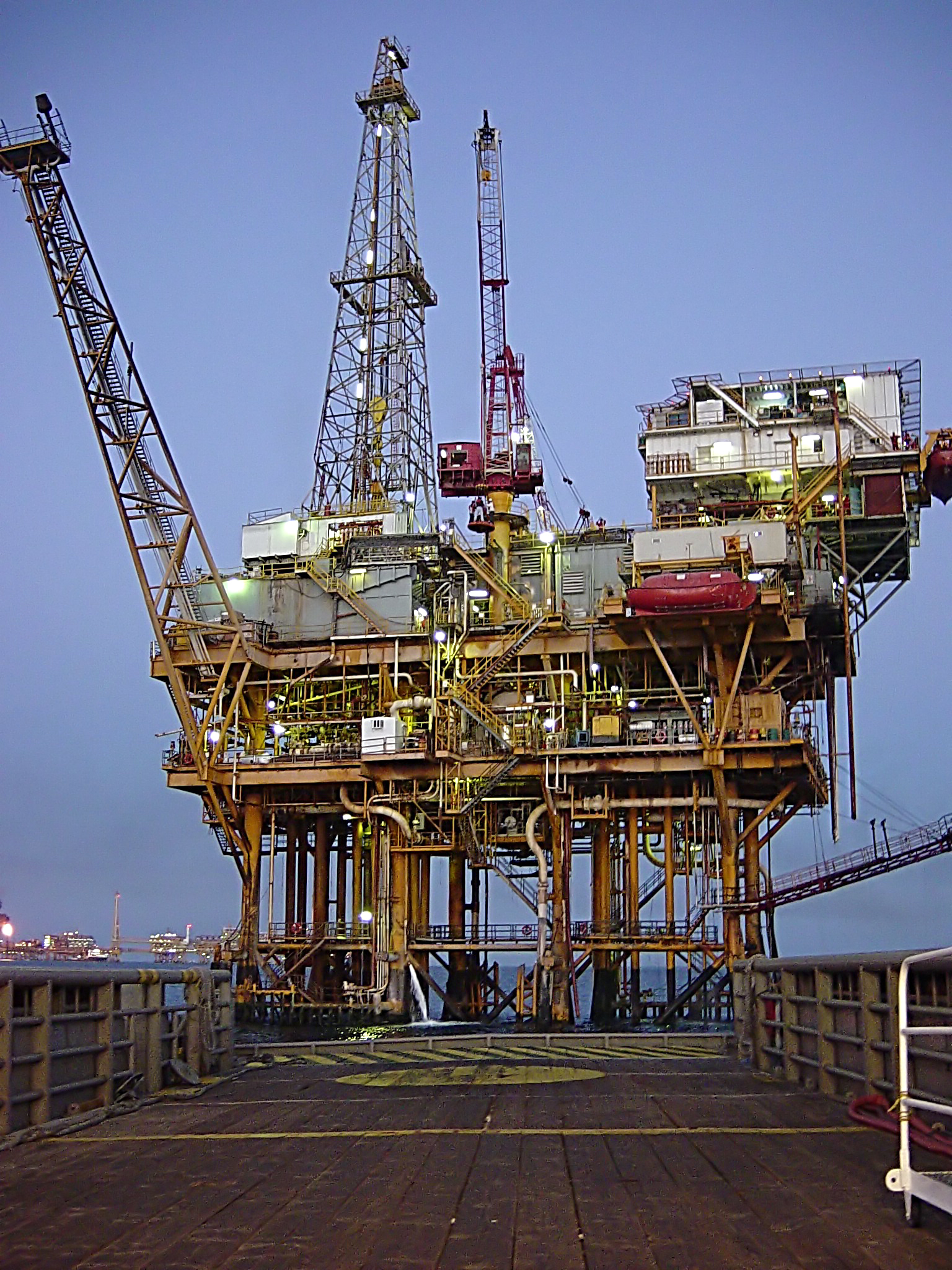
Photos: Oil rig (Wikipedia), Hummer (Hummerreports.com), Plug-in Prius (Autospectator.com)