On Monday, I had the opportunity to sit in on a talk by Joe Romm, author of the Climate Progress blog. He's a physicist by trade, and an incredibly bright guy. He's worked in the clean energy sector for decades, and recently joined the ranks of the Center for American Progress to blog about climate change science and policies.
Joe Romm must be the most frustrated guy in the world. He has a vast wealth of knowledge about climate change, climate policies, the coverage of the media, and all the subtleties and details of what needs to be done, and of that, what isn't being done at all.
As the health care bill in the Senate nears final reconciliation, more focus can be put on the energy and climate agenda that has been stalled there for months. After the House passed sweeping climate legislation in June, the momentum was lost in the sluggish upper chamber, where a supermajority must nominally be in agreement in order to prevent a filibuster and pass any legislation. This is the fact that served to drastically water down the Senate version of the health care bill and will likely do that same, or worse, to the Senate climate bill.
Currently, there are several iterations of climate/energy legislation in the Senate. The energy bill that has passed out of the Senate Energy and Natural Resources Committee, the American Clean Energy Leadership Act of 2009 (ACELA), has been stalled there, pending possible incorporation of climate mitigation provisions (or, more likely, absorption of certain ACELA provisions into a climate bill). ACELA has at least some bipartisan support, having been approved by Lisa Murkowski (R-AK), Sam Brownback (R-KS), Bob Corker (R-TN), and Jeff Sessions (R-AL), along with the 11 Democrats on the committee.
Then there are the two-and-a-half climate bills on the table in the Senate.The first is the one co-sponsored by Kerry and Boxer, the Clean Energy Jobs and American Power Act (CEJAPA). This was the bill that much of the hype was centered on following the passage of the House bill (ACES), but which seems to have gone nowhere fast. Another is the Cantwell-Collins bill, the Carbon Limits and Energy for American Renewal (CLEAR) Act. CEJAPA is modeled much more closely after the successful House bill, but seems to be going nowhere fast, while CLEAR not only has bipartisan co-sponsorship, but has been praised by many groups for its simplicity and seeming fairness.
The “half” bill is the Graham-Kerry-Lieberman so-called “tripartisan” compromise, which has not actually manifested in the three months of hype surrounding it.While it will certainly receive the support of Senator Graham, however, it will be very difficult to muster the support of other Republicans, who seem to have taken a party-line stance firmly opposing carbon-reducing public policy. Senator Graham has taken some very brave actions in standing up to South Carolina tea-bagger conservatives, while other moderate Republicans—and unfortunately, a sizeable number of Democrats—have been giving less-than-impressive indications of their position on climate legislation.
While most Senate Democrats are still on board with the notion of a climate bill passing this year, many have begun to backtrack in the wake of health care legislation. And while Joe Romm writes off extensive reporting on their misgivings as being spurious, it should still be alarming to see statements from so many Democrats expressing doubt about a bill’s passage when 60 votes are needed. Even Democratic Senators who intimately understand the nation’s climate and energy issues have suggested that there will be no bill this year. With so many Republicans dead set against any sort of climate bill (of 178 House Republicans, 8 voted for the bill there), broad Democratic support is crucial. Moreover, this year is likely a peak in Democratic strength in the House and Senate, as Republicans are projected to make gains in the November elections in both houses.
A report released by the National Wildlife Federation in late December shows that an overwhelming majority of Americans support climate legislation. And what’s more important than what the majority of Americans think (sorry, ideal democracy), the United States needs to prove to the rest of the world that it really will take a leadership role on curbing greenhouse gas emissions, or the other main perpetrators will never follow suit. The US Senate is so enmeshed in childish politics that it doesn’t seem to pay any heed to science or reality. But the reality is, climate change is already taking its toll. And a final bill needs to be passed this year, bar none.
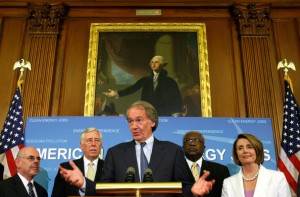
Images: Senators Bingaman and Murkowski (DailyLife.com), Senators Kerry, Graham, and Lieberman (mnn.com), Senator Mary Landrieu (Politico)
Keeping with last post’s theme, let’s talk about the worst-case scenarios of climate legislation, and worst-case scenarios of neglecting to pass climate change legislation.
What is the worst-case scenario for opponents of climate legislation? Firstly, the Congressional Budget Office and the Environmental Protection Agency have separately come up with figures for approximately how much American households will pay per year as a result of House-proposedcap-and-trade scheme—ranging from $80 to $175 per household per year (about the price of one stamp per day, at the most). Of course, groups like the Heritage Foundation and influential demagogues like Sean Hannity and Glenn Beck have repeatedly pushed their own numbers, though they clearly have their own partisan (not to mention myopic, irresponsible, and gravely detrimental) agenda, and these numbers have been thoroughly debunked.
There are other potential negative consequences of a cap-and-trade bill than just Americans paying more money. American trade-exposed, energy-intensive industries could certainly be hit hard. Having to pay for emissions could cause industries to lose their competitive edge with similar firms overseas that do not have comparable legislation in effect. People associated with carbon-intensive power production, such as coal miners and oil extractors, could find their industries gradually contracting, and new jobs may be difficult to come by, as skills may not be immediately transferable to jobs in the clean energy sector.
I will not deny that Americans may have to pay more on their energy bills a few years from now, if legislation goes into effect. They will be only partially internalizing the vast and deleterious externalities of the energy that is generated in this country. But there are provisions in the House climate bill that will protect industries, and even utilities, from overly burdensome costs, and prevent offshore competition from undermining greenhouse reduction goals and attracting American industries to relocate and consumers to buy more imported goods. If these provisions are included in the final version of the reconciled House-Senate bill, they need to be tweaked to address issues of implementation and administrability, but they can keep our manufacturers competitive and sustainable in the long run, if manufacturers are smart about investments in energy efficiency (with the free allowances they will receive) and other GHG-reducing measures.
As for greenhouse gas-intensive generation industries, such as coal and oil, I appreciate that over the long term, they may lose out. Indeed, fossil fuels burned for electricity production are the largest emitter of greenhouse gas in the US, and in the world. If we are serious about combating climate change, we need to take a serious look at coal, oil, and natural gas as major polluters and turn to less carbon-intensive sources of power and heat, as well as more efficient ones like combined heat and power plants and distributed generation.
Even so, electric utilities, especially ones with a large portion of coal generators, are given huge handouts in the House bill, and lawmakers are dishing out large amounts of cash to R&D for “clean coal technology,” a deceptively named prospect that, if actually developed, would keep coal plants alive and well throughout our country, maintaining the nefarious business of mountain-top removal and other coal extraction processes, while shoving CO2 beneath the earth and creating a slew of potential new problems with water toxicity and destruction of even more ecosystems.
And that’s if the bill does pass. What’s the worst-case scenario if it doesn’t? The short answer is, we have no idea. No one really does. But one pattern is abundantly clear. Every time climatologists have made an updated, more accurate model of what effects climate change could have on our planet, they have discovered that their models vastly underestimated the potency of feedback loops and the gravity of the consequences.
If we don’t pass comprehensive legislation, we will be contributing to the dismantling of countless fragile natural processes that have come to make our planet the livable world that it is. Climate change skeptics point out that there have historically been fundamental shifts in climatic conditions. Of course that’s true. But we didn’t cause them. And if we keep exacerbating these changes, we will continue to wreak havoc not only on other species, but also on our own species. There is no way to accurately predict the extent of the increase in flooding, erratic weather, aridity, sea level rises, and temperature increases. And these will lead to increased propensity for disease, malnutrition, climate refugees, strife and warfare, and now, as even the Department of Defense has come to acknowledge, huge national security risks.
Not addressing climate change—both as a nation and as a united coalition of nations worldwide—would probably be the most foolish and profound blunder ever carried out by mankind. And yet, as we approach the Copenhagen international climate summit in December with almost no chance of having a US climate bill passed, it’s beginning to look like maybe Americans really will be the ones who took the lead on letting our species slowly but surely allow the world's climate to change fundamentally, and without possible reversal of our actions. We are in the midst of one of the most important democratic undertakings in the history of the world, and it seems like we the people are either completely oblivious, heinously indifferent, or just infinitely greedy.
Yes, your electricity bill might increase. Just think of it as paying a little bit to charity every month—a charity that will help prevent thousands of other charities from having to do some of the work that will inevitably need to be done to adapt to climate change, help care for the diseased, provide refuge for displaced persons, and the innumerable other services that will need to be met to cope with a changing climate. Or just oppose the bill and let your children and grandchildren deal with the consequences.
Only days after I wrote about the power of special interest lobbies in Congress versus the power of the American people as a whole, an interesting story broke. According to the Times:
A grass-roots lobbying firm has acknowledged forging letters opposed to the climate bill that were sent to a Virginia lawmaker. The office of Representative Tom Perriello discovered that a half-dozen letters it received had nearly identical language signed by a made-up person at Creciendo Juntos, a Latino group, and five fake members of the Albemarle-Charlottesville branch of the N.A.A.C.P.
So here we have the powerful, corporation-financed professional lobbyists—who already have a great deal of clout among Congress members and often win victories for companies whose actions are harmful to the public good—posing as members of nonprofit organizations that seek to give a voice to historically voiceless or powerless communities, in order to block legislation that would disadvantage their clients.
The lobbying firm, Bonner & Associates, apologized to the groups and attributed the faked letters to a temporary employee who, it says, has been fired.
Well, problem solved, then, Bonner & Associates. Glad that meddlesome rabble-rouser is out of there! Shame they weren't able to catch him before the bill went to a vote.
How often does this happen when the perpetrators aren't caught? And how often do forged letters like these end up influencing Congressional votes? ACES only narrowly passed the House, and more moderate Congress members could have easily been swayed by a completely fabricated plea allegedly coming from important advocacy groups.
Even with a political system that is already tainted by unethical injections of money, greed, and power, those with the advantage still don't play fair. How can the public be served when the public seems to be neglected or undermined at every turn?
The U.S. House of Representatives just passed the American Clean Energy and Security Act of 2009by a margin of seven votes, 219 to 212. Kudos to Chairmen Waxman and Markey for taking the lead on the most crucial issue of the next several generations, the threat of global climate change. Many perceive the issue as an environmental one, and one that is only a victory for "environmentalists." But that couldn't be further from the truth.
As I have touched on many times, climate change is an all-encompassing issue that threatens a seemingly endless variety of other issues. You might personally believe that healthcare, civil liberties, war, or any number of other issues is a bigger priority than climate change, a supposedly futuristic notion predicated upon shaky science. But every issue being debated in the United States today can in some way be connected to climate change—or at least related policies.
Tom Friedman wrote in Tuesday's Timesthat weaning ourselves off of oil could serve to undermine oppressive oil-rich regimes in countries like Iran, Saudi Arabia, and Russia. Many countries rich from oil use their profits to invest in nuclear weapons or fund terrorism. Anyone care to do something about nukes and terrorists? Isn't that why we're in Iraq and Afghanistan (or at least Afghanistan)? Isn't that why we're so frightened of Iran?
If we don't address climate change, the healthcare issue will only be exacerbated. Airborne diseases will increase with increased temperatures, including potential epidemics for which we are ill prepared.
Even the agricultural community in the United States, who lobbied hard enough to essentially fend off any potential regulation of greenhouse gas emissions in the agricultural sector, would be drastically affected by even a minor change in temperature and climate conditions. But the major problem here is that no one thinks in the long term.
And that is exactly whyRepublicans, only eight of whom voted for the legislation today, are able to exploit it for political gains. 'It only amounts to a tax,' they say. 'It will only hurt American business and force consumers to pay more for their heat, power, and gasoline.'For them, it's not about preventing disaster across the world. It's about winning back a Republican majority in the United States Congress by exploiting myopic concerns. But climate change is not just an environmental issue, and it's sure not a partisan issue.It has somehow devolved into both over the course of the debate on regulation, and will inevitably cause forward-thinking politicians to lose their seats. This is the unfortunate reality in a democracy like ours of standing up for what is right, even if it may not be exceptionally popular in the short run.
So the Waxman-Markey bill, even though it was watered down excessively to cater to wealthy businesses and utilities and power-wielding lobbyists, has finally passed. No one knows if it will accomplish anything near what scientists say we need to. But at least it's a start. And now the issue will move on to the Senate, where it will be diluted even more, and progress will only be hindered further. In 40 years, we'll all look back at this and wonder how we could have been so ignorant. Those who opposed the bill are on the wrong side of history, just as the anti-civil rights folks were in the '50s and '60s. But in the realm of climate change, by the time that fact is universally accepted, it could very well be too late.
H.R. 2454, the American Clean Energy and Security Act, finally passed through the Energy and Commerce Committee of the House a few weeks ago, after weeks and weeks of tough negotiations, and lots of unfortunate compromises that will only serve to further slow the process of cutting carbon emissions in the United States. Henry Waxman and Ed Markey, the crafters of the original bill, have since been meeting with lawmakers in the House, explaining to them the functions of various components of the bill, as well as the "safety valves" encouraged by more conservative Democrats like Rick Boucher, who have also recently been promoting the merits of the bill to Congress.
Now, with Speaker Pelosi interested in calling the bill to a floor vote possibly within a week, one great obstacle has stood in the way of passage: the House Agriculture Committee. The chair of the committee, Collin Peterson, a Democrat who represents all of western Minnesota, has remained stubbornly opposed to the bill's passage, not because it directly impacts farmers, but because it doesn't benefit them enough. Peterson wants to be able to enhance the ability for farmers and agrobusinesses to reap the benefits of biofuels such as corn ethanol, as well as give them more opportunities to sell carbon offsets to other polluters.
The ag business community is most fervently opposed to the Environmental Protection Agency (EPA) having any role in compelling them to monitor their greenhouse gas emissions, and Peterson actually sponsored an amendment to cut off funding for the EPA's analysis into whether corn ethanol actually has such a great deal of indirect carbon emissions associated with its life cycle that it is in some ways more harmful than gasoline. Cutting of funds for a scientific analysis—now there's a useful way to get your agenda across.
And Peterson's committee is certainly not the only one that's helping to squander our best chance to address climate change. The House Appropriations Committeee just approved an interior appropriations bill establishing the EPA's budget for fiscal year 2010, but incorporated two amendments wherein 1) the agency is not allowed to tell farmers to even report their emissions, and 2) all livestock operations are exempt from possible future climate regulations. The ag lobby seems to have Congress right where they want them.
My problem this year is it's been so cold that the crops aren't coming up. And they're saying to us, 'Oh, it's such a big problem because it's going to be warmer than it usually is.' My farmers are going to say that's a good thing—we're going to be able to grow more corn.
Well, while south Asian countries are being flooded, Pacific islands are submerging, desertification is rendering African farmland unusable, ice caps are melting, weather conditions are becoming more erratic, and millennia-old ecosystems are being quickly destroyed, at least Minnesota farmers might have a few good harvests.
Even as nearly every industrialized nation has adopted greenhouse gas emissions policies and regulations in some form, the United States has steadfastly maintained its role as a laggard in helping to mitigate the worst effects of climate change. Now, with an Administration that recognizes the gravity of the issue and a Congress that largely supports measures to address it in some manner, the tide has turned in favor of legislation that will prompt us to play a role in an international response to an international threat.
However, even with a large Democratic majority in the House and Senate, legislation that would sufficiently contribute to mitigation to reduce some of the most catastrophic effects of climate change—according to the Intergovernmental Panel on Climate Change—have proved very difficult to garner widespread Congressional support.
More moderate to conservative House Democrats have already succeeded in watering down the American Clean Energy and Security Act, a bill co-sponsored by Reps. Waxman and Markey. And while the bill has passed through the Energy and Commerce Committee, it still faces scrutiny and further dilution from other House committees, and eventually from the House at large. Meanwhile, a notably weaker bill will undoubtedly spawn from the Senate in the coming months.
With such a serious crisis threatening our planet, and widespread scientific consensus calling for a comprehensive international response, it is sometimes baffling to consider that so many decision-makers remain opposed to action. Why did all but one Republican on the Energy and Commerce Committee vote against the bill, and why is it so difficult for more conservative Democrats to sign on?
Conservative politicians cite projections of economic cost as the major barrier to passing bold legislation. Many Republicans have repeatedly informed the public that the Waxman-Markey bill amounts to an energy tax. And this tax, like any other, they say, will distort the natural incentives that guide the American economy, resulting in decreased GDP growth and shrunken consumer pocketbooks, at a time when our economy cannot afford further contraction.
However, the economic models used by the Environmental Protection Agency (EPA), the Energy Information Administration, and prestigious universities worldwide almost invariably predict that a comprehensive climate change policy will damage the economy, not because it will, but because of how the models are designed. They invariably assume our economy is already operating at its most efficient state, so any deviation is perceived as harmful.
On the other side of the analytical divide are the models of the climate and energy NGO community and a handful of government entities and universities that make an effort to accurately model the benefits of climate policy in terms of jobs, economic growth, and consumer savings, as well as the avoided costs of inaction. These models are no less rigorous in quality of data and technical methodology than those of conventional economists, yet they have comparably little influence on climate change policy debate.
The EPA's ongoing efforts to quantify the economic benefits, as well as the costs, of the Waxman-Markey bill are commendable, but not sufficient. The benefits calculated in their models will be just a narrow subset of all probable benefits, and will provide little extra impetus for essential legislative action. Until the discipline of economics undergoes a fundamental reorientation, policymakers and the public must take economic estimates of the costs of energy and environmental policy with many grains of salt, and should be ready to proceed with or without their approval.
The United States needs to take bold action as soon as possible to begin to address climate change. And such action will indeed require a great deal of federal spending on tax incentives, research and development, and subsidization of certain emerging green technologies, among other programs. But when accurately accounting for the economic and social benefits of such legislation, it becomes abundantly clear that it is in our nation's best interest to act, and act now.
Special thanks to Chris Knight for contributing to this post.