The prosecution says that Lodie then called up Robert Iacoviello, a suspected Blood member, who then ambushed Talbot while Talbot and Lodie argued. Two other individuals have been charged - Gia Nagy and James Heang - as accessories after the fact for storing and helping to get rid of the murder weapon (which has not been found - see comment below, the alleged murder weapon has been recovered).
In all, Lodie is getting off pretty easy, considering that in Massachusetts if you are an accessory before the fact in a felony you are punished in the manner of the principal (i.e. he who committed the felony.) So, in essence, Lodie got 8-12 years for killing a cop, which is a pretty lenient plea deal given the alleged crime.
It's hard to say what role Lodie's plea change will play in Iacoviello's upcoming January trial. The media is not saying whether Lodie will testify for the prosecution, though I cannot think of another reason to give Lodie 8-12 years for this. The DA's office, however, states that Lodie did not sign a cooperation agreement. Hopefully during trial the videotapes of the event (there is some fear that they have been damaged or destroyed) are made public so that we know what truly happened that fateful morning behind Revere High.
When Barack Obama was elected president we heard about his seeming obsession with our 16th president. He read books on Honest Abe, used his bible at his inauguration and even themed the January festivities after the top hat enthusiast's famous Gettysburg Address. Given all of this Obama must have come across one of Lincoln's most famous quotes, uttered in his famous speech named for the quote, that "A house divided against itself cannot stand." Now Lincoln was alluding to the dispicable practice of slavery in the States, but if we twist the quote a little bit and make it "A party divided against itself cannot stand," we see trouble looming for Democrats.
Yes, I'm going back into the realm of the public option. That elusive Ross and Rachel portion of the health care bill (on-again, off-again: lame Friends reference, forgive me). President Obama said back in August it wasn't essential to the bill. In September House Speaker Pelosi said it was essential while at the same time House Majority Leader Hoyer said it wasn't. In other words, there was no Democratic leadership on the issue, and that lack of leadership continues today over the public option.
Here is why, if we get a public option, it will be watered down: the Democrats are running around like chickens with their heads cut off. Are they really unable to sit down, say this is our plan, and just stick to it? It's funny that Obama will take a risk on the 2016 Olympics for Chicago (read: going to Copenhagen without knowing for sure that Chicago would win the bid) but when it comes to insuring millions of Americans he doesn't want in unless he is guaranteed a victory. Schumer is saying one thing, and reports come out indicating the opposite. Reid could emerge as a leader on this, and Obama undermines that.
I would love to be proven wrong. I would love to get a robust public option that really shakes up the insurance industry and gives a decent level of care to millions of uninsured Americans. The problem is that no clear leader is emerging in this fight and the very backroom politics that is supposed to be used to get votes and get things done is creating miscommunications within the party and leaves the public scratching their heads and opponents on the offensive. Like Lincoln (kind of) said: "A [party] divided against itself cannot stand [for anything]." The problem is they're falling on us.
And before you say "Well, Goldman only got $10 billion in TARP funds and paid it back." What we seem to forget is that Goldman underwrote a lot of AIG debt, meaning if AIG defaults without government assistance, Goldman's $3 billion+ earnings this year turns into a multibillion dollar loss. Additionally, Goldman still has to buy back its warrants from the government, which it is shrewdly trying to do below market prices. Talk about appreciation for bailing them out.
Additionally, before we kid ourselves, Wall Street is back to its old ways, only this time it's not with people's mortgages; it's with their lives. They are packaging life insurance policies the same way they did with mortgages, and then hoping that the people they bought the policies from (the elderly and sick, to name two categories they are targeting) die quickly so they get a bigger return on the payout.
When I called Congressman Barney Frank's office and began asking questions about Mr. Frank's willingness to enter legislation to rein in firms that received TARP money but technically paid it back (again, the issue of warrants and AIG underwriting emerges here in terms of Goldman, at least), I was transferred to the House Finance Committee. The nice woman who picked up the phone explained to me that while the House has been working on shareholders' rights issues and corporate governance (where this executive pay cut seems to be stemming from), for firms like Goldman there is no recourse because of the TARP fund issue. When I asked if she knew if the Committee would be introducing legislation to rein in executive pay at firms like Goldman, she said she did not believe so. When I asked if it was even on their docket, she referred me back to the whole shareholder's rights issue and that they have done what they could. When I characterized it as a "Do what you can now, deal with others later"-type situation, she agreed. Going after a firm like Goldman would require a) a serious backbone (they have a lot of money, and C.R.E.A.M. is not just a Wu-Tang song) and b) hard work. Both seem to be in short supply right now in Washington.
I guess when you have Geithner's ear whenever you want it, you can get a lot done. So while most Americans toil and grind each day out at work for less than they used to get (granted they still have a job), the fat cats on Wall Street, who would have lost their McMansions had we, the taxpayer, not bailed them out of a problem that they created themselves, are living it up and will see massive profits and massive paychecks. I guess what's good for Wall Street is not necessarily good for Main Street.
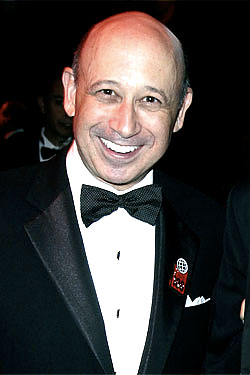
Photo - Lloyd Blankfein, Goldman Sachs CEO (NY Mag)
I found myself scratching my head at two recent stories about terrorism here in the United States. One being the recently announced plot to attack malls and kill civilians and first responders, the other being a little-known arrest in Orange County, New York, of a teenager who had planned to resurrect the horror felt during the Columbine massacre by attacking his school in the manner that Eric Harris and Dylan Klebold did. Both are clear-cut cases of mass murder meant to cause fear and kill innocents. Yet the teenager gets arrested and goes to a psych facility and the mall killers are thrown into federal custody. Why the disparity?
It reminded me of another terrorism double-header from a few weeks ago. We all know the plot of Najibullah Zazi - the Afghan immigrant with ties to New York and Colorado who allegedly planned to set bombs off at large transit centers in the United States. Another arrest occurred a couple of weeks later involving possible plots of mass murder and bombs: that of Vincent Pizzonia in Suffolk County on Long Island. He accidentally detonated a bomb he was making and was found with more bomb-making materials and pictures of the interior of Columbine high School, as well as pictures of Harris and Klebold. Pizzonia was not even arrested and school administrators were mulling over whether they should allow him back to school. If those pictures had been of a major transit hub and Osama bin Laden rather than Columbine and Harris and Klebold, would we be in the same situation?
I'm not saying what we should do with folks like Zazi or Pizzonia, though a uniform way of dealing with terrorism situations would be helpful. We just need to recognize that terrorism is terrorism, whether done by a follower of Islam or a pissed-off white kid. If you have plans to harm innocents with weapons like assault rifles or explosives because you disagree with people, that would make you a terrorist. Whether you plan to do it at a school or at a train station, in the name of some twisted form of Islam or because you feel left out, it is terrorism.
When we focus on certain groups involved with terrorism (radical Muslims) and brush aside other groups (isolated suburban white kids) we lose sight of the simple fact that terrorism knows no color or ethnic boundary; it is not isolated in one particular demographic. Why do we reserve the word for some, but not others? Why do we torture some, but counsel others? Attacks on innocents are never called for, no matter who perpetrates them. Peace.
Mr. Mukasey's overall thesis seems to be that we should not try terrorists, specifically those held at Guantanamo, in United States civilian courts because it's hard and we did it in the 1990s and that led to 9/11. Mr. Mukasey uses flimsy examples to back this thesis and leaves the reader wondering how any connection between civilian trials for terrorists led, in any minute way, to the horror this country experienced on September 11, 2001.
One danger Mr. Mukasey points out is the proselytization of individuals behind bars, insinuating that if we do not try terrorists apprehended overseas in civilian courts, the problem will somehow be diminished. As a former Attorney General, Mr. Mukasey should be very familiar with the prison system. To suggest that the type of radical proselytizing he so fears is not occurring currently and will somehow be managed if we do not try terrorists in our own courts is ludicrous. A periphery look at the prison gang system alone tells us that proselytization behind bars is an established institution that will not be effected by the current administration's policy on where to try suspected terrorists.
Then comes Mr. Mukasey's most outrageous statement. He infers that Osama bin Laden did not know that the American government was "aware" of him until he was in possession of the indictment - which listed him as a co-conspirator - stemming from the 1993 World Trade Center bombing. He additionally calls Mr. bin Laden "relatively obscure." Anyone who is familiar with a man named Ronald Reagan should know about the mujahideen, who Reagan called "freedom fighters." One of these "freedom fighters" was Osama bin Laden, who played a major role in the war (during which he founded Al-Qaeda) and returned to his native Saudi Arabia in 1990 as a hero of jihad. To state that Mr. bin Laden must have believed that he was flying under America's radar until he received that indictment, even as he was publicly criticizing Saudi Arabia for its supposed dependence on our nation's military, involves dishonesty, ignorance, or both.
Mr. Mukasey also points to prison violence as a reason to keep suspected terrorists in off-shore custody and to try them in non-civilian courts. He points to the case of a co-conspirator of the Kenya and Tanzania embassy bombings who committed an egregious act of violence against a Bureau of Prisons guard. Prisons are violent places; people are held against their will for running afoul of the law. To suggest that the act of violence Mr. Mukasey portrayed would not have occurred if the prisoner was held elsewhere seems to be off the mark. These are, after all, people accused of killing innocent people for no good reason; if they did, in fact, commit these heinous acts, what is to stop them from being violent behind bars - whether it is here or abroad?
Finally, Mr. Mukasey seems to take exception to the fact that the death penalty was not utilized in the embassy bombings case and that current Attorney General Eric Holder has taken the death penalty off the table for a sixth embassy bombings suspect. Mr. Mukasey looks past the fact the death penalty may not be a very effective deterrent to a group of individuals whose tactics include blowing themselves up to hurt others. Being held in a prison run by the very government you despise and have vowed to destroy, within the same borders of a country you have detested might be a little more ominous than becoming a martyr by being killed by that very same country to hasten your arrival in whatever twisted afterlife scheme you have been made to believe.
Mr. Mukasey says that in return for trying terrorists in civilian courts in the 1990s, our country got the 9/11 attacks. He does not delve into Middle East instability, the United States' covert war in Afghanistan and the proliferation of weapons in the area, or the lack of addressing the power vacuum instigated by the Afghan Civil War as possible precursors to global terrorist activity. Instead he points to trying terrorists in civilian courts in the U.S. during the 1990s as THE reason for 9/11. His op-ed was insulting to its readers who possess a cursory understanding of global history and should have been vetted better by the editorial board. Thank you for your time.
This letter was sent to the Wall Street Journal Opinion Editors on Monday October 19, 2009, the same day that the Mukasey editorial ran
Given my last politics post about Obama's promises seemingly not coming to fruition in the near future, I have done a lot of thinking about the state of politics for folks my age. No one needs to tell us the world has changed significantly the past few years; we just exited some of our most politically active years (college) during a time of two physical wars (Iraq and Afghanistan) and one war on a buzzword (terror) during a presidential administration that rivaled Nixon in cringe inducement. We rallied behind Obama only to see political causes we cared about (closing our generation's version of wartime internment manifested in Guantanamo, securing equal rights for our gay friends and coworkers) pushed to side to focus on inevitably falling short on true healthcare reform.
We saw a very similar thing happen in the late 70s with Carter taking over a sub-par Ford administration and coming up short. That ushered in Ronald Reagan. Reagan was the 1980s Republican Obama: a change from the previous administration, well-spoken, relatable, and popular. He was so popular that even after countless scandals (Iran-Contra being one of the largest), an incredibly reckless covert war in Afghanistan that led to the rise of the Taliban and one Osama bin Laden, an unbelievable increase in government spending and expanding of government, his vice president was elected president. The effect of Reagan's presidency did not end there, though, as Bush I's pledge of "no new taxes" was sacrificed in the wake of Reagan's aforementioned government spending and Clinton pounced on it in 1992. Yet Reagan is looked back upon as the father of modern conservatism; so much so that in the 2008 Republican primary debate held at his presidential library, the candidates sat around and tried to channel the Gipper to appeal to their base.
And this is where the problem lies for Republicans. Just like the Democrats are using their playbook from the 1990s (which, lest we forget, led to an embarrassing presidential election loss in 2000 in what would today look like Reagan-Mondale, with Bush clearing brush for the next 8 years instead of taking orders from Cheney), the Republicans are living in the past. Three of the major Republican candidates last election (Brownback, Huckabee, and Tancredo) stated that they did not believe in evolution. How can the party evolve when some of their most well-known leaders would like to make the Scopes trial relevant again?
So this is where we are: Democrats are stuck in the 90s and Republicans are stuck in the 80s. So where does that leave the people living in the 21st century? Stuck. If we become disenchanted by Democrats (which is a road many of us are heading down), where are we going to turn? Rush Limbaugh and his polarizing rhetoric? We don't want to cry with Glenn Beck and we don't want Michael Steele acting like our "hip" uncle who thinks he's "down" with us youngsters. It's as if we're entering another Gilded Age: as weekly wages of the average American have declined, payouts on bailout-laden Wall Street will see record numbers this year. Politics seems to be at a standstill and the two-party system is as broken as our healthcare system. Obama talks a great game, but just cannot seal the deal, while the Republicans are not even trying. The Democrats still have time to turn things around, but we'll have to skip a few evolutionary steps to get there. Peace.
Keeping with last post’s theme, let’s talk about the worst-case scenarios of climate legislation, and worst-case scenarios of neglecting to pass climate change legislation.
What is the worst-case scenario for opponents of climate legislation? Firstly, the Congressional Budget Office and the Environmental Protection Agency have separately come up with figures for approximately how much American households will pay per year as a result of House-proposedcap-and-trade scheme—ranging from $80 to $175 per household per year (about the price of one stamp per day, at the most). Of course, groups like the Heritage Foundation and influential demagogues like Sean Hannity and Glenn Beck have repeatedly pushed their own numbers, though they clearly have their own partisan (not to mention myopic, irresponsible, and gravely detrimental) agenda, and these numbers have been thoroughly debunked.
There are other potential negative consequences of a cap-and-trade bill than just Americans paying more money. American trade-exposed, energy-intensive industries could certainly be hit hard. Having to pay for emissions could cause industries to lose their competitive edge with similar firms overseas that do not have comparable legislation in effect. People associated with carbon-intensive power production, such as coal miners and oil extractors, could find their industries gradually contracting, and new jobs may be difficult to come by, as skills may not be immediately transferable to jobs in the clean energy sector.
I will not deny that Americans may have to pay more on their energy bills a few years from now, if legislation goes into effect. They will be only partially internalizing the vast and deleterious externalities of the energy that is generated in this country. But there are provisions in the House climate bill that will protect industries, and even utilities, from overly burdensome costs, and prevent offshore competition from undermining greenhouse reduction goals and attracting American industries to relocate and consumers to buy more imported goods. If these provisions are included in the final version of the reconciled House-Senate bill, they need to be tweaked to address issues of implementation and administrability, but they can keep our manufacturers competitive and sustainable in the long run, if manufacturers are smart about investments in energy efficiency (with the free allowances they will receive) and other GHG-reducing measures.
As for greenhouse gas-intensive generation industries, such as coal and oil, I appreciate that over the long term, they may lose out. Indeed, fossil fuels burned for electricity production are the largest emitter of greenhouse gas in the US, and in the world. If we are serious about combating climate change, we need to take a serious look at coal, oil, and natural gas as major polluters and turn to less carbon-intensive sources of power and heat, as well as more efficient ones like combined heat and power plants and distributed generation.
Even so, electric utilities, especially ones with a large portion of coal generators, are given huge handouts in the House bill, and lawmakers are dishing out large amounts of cash to R&D for “clean coal technology,” a deceptively named prospect that, if actually developed, would keep coal plants alive and well throughout our country, maintaining the nefarious business of mountain-top removal and other coal extraction processes, while shoving CO2 beneath the earth and creating a slew of potential new problems with water toxicity and destruction of even more ecosystems.
And that’s if the bill does pass. What’s the worst-case scenario if it doesn’t? The short answer is, we have no idea. No one really does. But one pattern is abundantly clear. Every time climatologists have made an updated, more accurate model of what effects climate change could have on our planet, they have discovered that their models vastly underestimated the potency of feedback loops and the gravity of the consequences.
If we don’t pass comprehensive legislation, we will be contributing to the dismantling of countless fragile natural processes that have come to make our planet the livable world that it is. Climate change skeptics point out that there have historically been fundamental shifts in climatic conditions. Of course that’s true. But we didn’t cause them. And if we keep exacerbating these changes, we will continue to wreak havoc not only on other species, but also on our own species. There is no way to accurately predict the extent of the increase in flooding, erratic weather, aridity, sea level rises, and temperature increases. And these will lead to increased propensity for disease, malnutrition, climate refugees, strife and warfare, and now, as even the Department of Defense has come to acknowledge, huge national security risks.
Not addressing climate change—both as a nation and as a united coalition of nations worldwide—would probably be the most foolish and profound blunder ever carried out by mankind. And yet, as we approach the Copenhagen international climate summit in December with almost no chance of having a US climate bill passed, it’s beginning to look like maybe Americans really will be the ones who took the lead on letting our species slowly but surely allow the world's climate to change fundamentally, and without possible reversal of our actions. We are in the midst of one of the most important democratic undertakings in the history of the world, and it seems like we the people are either completely oblivious, heinously indifferent, or just infinitely greedy.
Yes, your electricity bill might increase. Just think of it as paying a little bit to charity every month—a charity that will help prevent thousands of other charities from having to do some of the work that will inevitably need to be done to adapt to climate change, help care for the diseased, provide refuge for displaced persons, and the innumerable other services that will need to be met to cope with a changing climate. Or just oppose the bill and let your children and grandchildren deal with the consequences.
As expected, Hiram Monserrate escaped the felon label and was convicted of only misdemeanor assault for recklessly causing injury to his girlfriend, Karla Giraldo, when he dragged her through the lobby of his building (the portion of the assault caught on videotape). I suppose we get to enjoy his presence in Albany for even longer. Peace.
Today the verdict in the case of New York State Senator, and state-wide embarrassment, Hiram Monserrate is expected to be delivered by Judge Erlbaum at 3:30 this afternoon. Monserrate faces four charges - two felonies and two misdemeanors - stemming from an incident last December in which he slashed his girlfriend's face with broken glass, requiring medical attention.
What would I like to happen? Monserrate catches both felonies, loses his Senate seat, and ends up in the clink. The reality of the situation, in my mind, will probably be different. Now, Judge Erlbaum seems like a guy that doesn't take any crap, and if anyone would convict Monserrate of these felonies, it would be him. But be that as it may, there are two indications that Monserrate will not be convicted of a felony (and thus will not lose his Senate seat). 1) His girlfriend, Karla Giraldo, changed her story (and perjured herself). She told doctors at the hospital that Monserrate had intentionally attacked her, but when questioned by detectives she stated that the whole thing was an accident. In addition to this, she contradicted her grand jury testimony and told the court during trial that she showed up to Monserrate's apartment drunk. Pile this on top of the fact that we are working within a flawed system (the same system that allowed Pedro Espada and Monserrate to hold up the State Senate for weeks) and you have large potential for misfiring here.
I think the following will happen: Monserrate will be convicted of the two lesser misdemeanors and be acquitted on the felonies. In this way, everybody loses, as Monserrate is "punished" (read: probation and a fine) and we as New Yorkers get to continue to enjoy his presence in the New York State Senate. I guess we'll just have to wait until 3:30. Peace.
Photo - Monserrate and a fake tan/bronzer victim (Gothamist)
All three of you who read this blog voluntarily know that during the presidential campaign last year, I was all about Obama. I stood in line for over an hour just to cast my vote in a blue state, I believed that he would be the change that Washington desperately needed, and I thought he could get the job done. I have been sorely disappointed. In recent conversations with friends of mine, I found out that the frustration I've been feeling is not unique among the progressive crowd.
So when I awoke this morning to a CNN News Alert on my phone saying Obama had won the Nobel Peace Prize, I thought to myself, "For what?" What, exactly, has Obama accomplished in his first 10 months in office? He has failed to lead his party in the fight for healthcare. Instead, he wants to work with Republicans and their respective crazies (Chuck Grassley, I'm looking at you, you crazy old man) and has thusly sacrificed the most important part of reform, the public option. He and his Democratic colleagues have equivocated, waffled, and downright fumbled healthcare reform and all other progressive initiatives (we'll close Guantanamo, oops, not when we said we would).
Obama has also stated that he personally would like to dismantle the Don't Ask Don't Tell policy, the abysmal diktat regarding gays in the military that is the result of Obama's Democratic predecessor's own equivocating and bending to right-wing illogicality. But if you expected him to actually do something to overturn the discriminatory policy, well, you might as well expect Glenn Beck to stop crying.
The Nobel Peace Prize committee has cited his ability to strengthen international diplomacy and his striving towards a world free of nuclear weapons. In reality, Obama is on the verge of increasing troop levels in Afghanistan and he oversees the second largest stockpile of nuclear weapons in the world. I understand that any Democrat would have a good chance of winning this award, as they would have ushered George W. Bush out of office, but this seems a bit preemptive (to borrow a term from the Wolfowitz doctrine embraced by Bush). It's like giving an actor an Oscar before filming starts.
Let's just take a step back for a moment. Obama has a pretty big mandate; we were sick of Bush and his 8 years of follies and we not only gave the country a Democratic president, but we gave the Democrats the House and 60 senators in the Senate. This is not a common occurrence, and what did the Democrats do? Pulled a classic Democrat move and blew it when it came to the most important issue of today: healthcare. But maybe we should have seen it coming, as this is the same party that lost the 2000 presidential election when it was a future (legitimate) Nobel prize winner versus George W. Bush.
The Democrats have everything in place and they are not using it. Instead of talking to and "working with" Republicans who want to spread death panel rumors and all of that, why not just push the legislation through Congress and sign it? The country gave you all those seats for a reason; they're not for decoration. Get on message, get Baucus and the other Blue Dogs in line and let them know they'll be facing tough primaries if they're going to pull the crap they've been pulling, and damnit Rahm, where is that badass everyone was talking about when Obama appointed you as his Chief of Staff? You let him go to Copenhagen without knowing Chicago was a sure thing? Seriously?
I've heard some say, "Wait until his second term, then he'll get his hands dirty." We didn't elect him in 2008 to get things done in 21013. He may not even have a second term if he continues to pussyfoot and not live up to his promises and what we put him in the White House for. Bipartisanship is dead, so as Ernie Anastos might say, stop fucking that chicken. Bush rammed a war based on outright lies we didn't need down our throats, and now Obama can't even get us healthcare reform when we desperately need it. I hope Obama changes his ways and gets serious on getting things done. He ran on hope, but we elected him to eradicate the need for it
Senators Max Baucus (D-MT) and Chuck Grassley (R-IA), ranking members of the Senate Finance Committee (Washington Independent)
Now that the Democrats have pulled a classic Democratic move by losing when they had all odds in their favor (for previous Democratic performances, see the 2000 presidential election), it is time to mourn to public option. That's right folks, the insurance system as it stands today has won the war on health reform, as their pockets will soon be lined by tax subsidies that the government will be giving out to Americans to shop around for their own insurance coverage. It's all right, though, because the insurance companies will play fair and follow the rules without strict government regulation, right Wall Street?
But we had to see this coming. It happened to Clinton in the 90s, and the powers that be (read: special interests and their lobbying arms) are just too entrenched to get anything done. Look at the massive amounts of money that they have donated to the folks responsible for the death of the public option. Chuck "Death Panel" Grassley has received $227,000 in the first half of 2009 alone from these interests. Max Baucus, the Democrat whose bill was supposed to garner wide bipartisan support but in reality was a bigger flop than a Vlade Divac offensive foul, has received $3.9 million since 1989 and is currently ranked fifth in terms of donations from the healthcare sector. It should be no surprise, then, that Baucus' plan had no public option.
But why do we need a public option so bad? Think about it: do you really think that the healthcare industry will police itself? No. Since that is a given, do you really think that the government will effectively ensure fairness in the insurance industry while making sure that those with horrible insurance or no insurance at all receive adequate coverage? If you do, then you're either a moron or have good enough insurance that you just don't care (this latter group, as indicated by the effort put forth by them, includes senators and congressmen).
A robust public option would have created what those in love with capitalism have wet dreams about: competition. How unfair would it be? The public option probably would not be that great to begin with, it would be a basic form of care. Those opposed to it on the principles (that great mass of people who refuse Medicare coverage because it is government-run) do not have to partake in it. To say that a public option would take down companies with a net income of more than $1.3 billion in 2008, or more than $1.2 billion sounds a little crazy.
But that's not even the point, as the popularity of a public option seems split according to public opinion polls. The point is that the Democrats have what has been deemed a "supermajority," a mandate if you will, that the country was sick of the way things were going and wanted to change things. Instead of ramming this legislation through Congress or making deals with their peers or doing whatever it took to fix this inherently flawed system, they held town halls, pandered to rumor mongers, and proved to the American people why bipartisanship simply does not work when you elect morons.
The death of the public option began (and in my opinion, ended) with the Senate Finance Committee. The committee shot down both public option amendments, and then in a twisted turn of events voted to restore $50 million for abstinence-only education. So how did Senate Finance Committee member Senator Chuck Schumer (D-NY), a staunch public advocate for th public option, feel about the day's activities? "We're feeling good," and "We're pleasantly surprised." In an utterly embarrassing day for Finance Committee Democrats (who outnumber Committee Republicans 13-10), Chuck Schumer says that he feels good about what took place? Two public options proposals were shot down and $50 million was allocated to a horrible educational curriculum that simply does not work. That's like Omar Minaya saying that the Mets have had a good couple of years.
So who's to blame for all of this? Democrats? Republicans? Tea bag nutjobs who don't understand nearly anything? That's a good start, but as we continue to vote in incumbents who really do not have our best interests at heart (if this bill affected their healthcare it would have been done decades ago and we would be pitying Canada for having such backwards, universal healthcare) and continue to allow special interest groups to dictate what we talk about in the media and in the legislative halls, we're only screwing ourselves. Because while the Chucks live in their own worlds - Grassley saying the government will pull the plug on grandma, Schumer saying two vote-downs of the public option and an increase in failed abstinence-only education is, essentially, a victory - we live in ours, and right now our healthcare system sucks and will continue to suck with no public option.