Showing posts with label war on terror. Show all posts

Monday, September 24, 2012

2012 Election Primer: Obama and Romney

Obama and Romney (Politico)
So after a bunch of requests (read: 3) to write up an election primer, I decided that it is time to give the people what they want: to know what a random 20-something in New York who thinks he knows more than he does feels is the best candidate to cast your ballot for in November.

I began this election season promising myself that I would vote for neither candidate and instead write someone in. President Obama, in my opinion (and I can't explain to you the amount of flak I've received for this) has been an underwhelming president when compared to the candidate he was in 2008. And that last sentence fragment is important: when compared to the candidate he was in 2008. All in all, Obama's done some good things domestically (repealing DADT, his better-late-than-never support of marriage equality, healthcare reform).

That's only one side of the coin, however. I've chronicled my disappointment with President Obama numerous times on this blog (here, here, and here to begin with). One thing that you'll notice about those articles (and most of my gripes about Obama) is that his foreign policy is, in a word, horrible. It is unfathomable to me that those who derided Bush's war mongering will defend Obama for 2012.

Obama is leading this country in the wrong direction, but not in the way that Fox News would have you believe. Precedents are being set in the Obama White House that could have dire consequences down the road.

For one, take the drone program (a program that is technically entirely classified). We have drones flying over many countries - countries with whom we are at war and countries with whom we are not at war. This sets a serious precedent for other countries who may want to fly drones over the United States when they get the same technology we currently have.

Moving beyond the precedent it sets, however, is the diplomatic damage that drone strikes carry given their civilian casualties. We conduct drone operations in countries like Pakistan, Yemen and Somalia; countries we are not at war with. This comes back to the precedent setting: can you imagine if Islamabad began flying drones, making strikes and killing American civilians?

A drone equipped with weapons and a camera (Wired)
But it's not only about the drones. It's about extralegal killings of American citizens in non-war zones. It's about a dubiously legal "kill list," despite a longstanding executive order against such assassinations. It's about not closing what will certainly be viewed as a black-eye on this nation in the form of Guantanamo.

Going back to precedents, Obama seems to be making the same, if not similar, mistakes his predecessors made in Afghanistan. During the Libya non-war, I decried the support for the untrained rebels fighting Colonel Qaddafi. Throwing supplies and intel at a group not ready for it is not good foreign policy. In fact, when I heard that the attack on the late Ambassador Chris Stevens was coordinated I wondered if any of the attackers were former Libyan rebels who had received training or materiel from the U.S. or other NATO nations. We've seen similar problems with green on blue attacks in Afghanistan in which US-trained Afghan forces attack US soldiers.

It is for these reasons that I simply felt that I could not vote for Barack Obama come November. That view is beginning to change, however, and it has nothing to do with anything Obama is doing.

I knew I was not going to vote for the Republican candidate no matter who it was. The post-Reagan conservative is simply too beholden to the religious right (cue the famous Barry Goldwater quote). You look at candidates like Rick Santorum or Rick Perry and you shake your head wondering what has happened to the Republican Party.

Now, Mitt Romney would appear to be the most palatable of the Republican candidates. Having lived in Massachusetts while he was governor and seeing the good things he did during that time (near-universal healthcare, turning around a large deficit), I have been amazed to see Romney backtrack from his accomplishments. In 2008 I asked a good friend his opinion of Romney and he replied that he was spineless and would say anything to get elected. His prescient statement has more than proven true.

We could get into the issues with Romney, but one problem is I simply don't know where he stands on anything. It changes so frequently that it makes Obama's flip-flop on gay marriage look like, well, evolution. Romney simply cannot choose one side of a position and keep it.

One thing I like in a president is transparency (this is another arena in which I've been disappointed with the Obama administration). Needless to say, the fact that Romney refuses to release his tax returns (a tradition started by his own father, to boot) does not sit well. The fact that he and his campaign allowed it to become a months-long campaign issue indicates to me that whatever he wanted to hide in the returns was worth hiding.

I was never going to cast my vote for Romney; that was decided well before he won the Republican nomination. But what Romney has done through his ridiculous missteps - the Egypt and Libya embassy attacks statement, the utter lack of specifics in any of his policy, the 47% irrationale - has made me so angry that I might actually vote for Obama out of spite for Romney. Romney's seeming ineptitude has moved me in such a way that I might actually vote for a president who I think is setting this country up for a very difficult foreign policy environment in the near and long-term future.

So to sum it up: I do not want to vote for Obama, but if voting for neither candidate would give Romney any kind of advantage (no matter how small) it actually may be irresponsible of me, given my worldview, to not vote Obama in November. I felt that the 2008 election was the first one in a while that gave the American people a chance to actually vote for a quality candidate, as opposed to the lesser of the two evils. And I maintain that Obama was a good candidate; he just could not live up to that candidate as president. This election will definitely fall into the "lesser of two evils category." I'm just angry that Romney's horrendous campaign may actually force me to choose one.

Tuesday, December 1, 2009

How Do You Solve a Problem Like Afghanistan?

You don't. I want to spin a quick yarn about a country back in the 1970s and 1980s that played a massive role in bringing down one of the most militarized nation-states in recent history. This country was a mountainous region with a very weak central government and was ruled over mostly by tribal warlords and religious extremists. When a very large nation-state to the north encroached on their territory and wanted to export their version of government, the tribal warlords and religious extremists mobilized against this foreign force. They eventually wore down the foreign army over nearly a decade, forcing them to withdraw. Now, we all know that the foreign army that retreated was the Soviet Union and the mountainous country it failed to keep under its control was Afghanistan. And clearly the story is a little more complex than a short paragraph (CIA Stingers, ISS corruption, etc.). But the fundamentals remain the same: the Afghan mujahideen was able to draw the Soviets into Afghanistan and then embarrass them on the world stage during the Soviet-Afghan War.

Fast forward to 2001 and while some of the circumstances have changed, the fundamentals remain the same. We've been drawn into Afghanistan by a Soviet-Afghan War veteran who understands how powerful guerrilla warfare tactics can be against a superior military. Compounding this, bin Laden has had two very lucky breaks. The first was Tora Bora in November, 2001 when we let him get away (a conclusion reached five months after the fact but made "official" by the Senate this week) and the second was Iraq. If we catch bin Laden in November we take out a major figurehead of the terrorist movement in Afghanistan and clearly and unequivocally send the message that you do not fuck with the United States. Instead bin Laden escapes because of crucial errors in judgment and tactics, becoming an even more mythic figure. Secondly, we go into Iraq, allowing Afghanistan to be relegated to red-headed stepchild status, with funds, troops, and materials diverted to the desert to find non-existent WMDs.

At the height of the Soviet-Afghan War, the Soviets had about 118,000 troops fighting in Afghanistan. With Obama's plan to send another 30,000 troops to the war-torn country it will bring American troop levels to about 100,000 (with an additional 45,000 NATO troops). We are, essentially, sticking to the game plan that the Soviets had back in the 80s, at least in terms of troop levels. If it did not work for them, what could possibly make those in Washington think it will work for us?

We could sit here all day and talk about the failures of the past 8 years in Afghanistan, but that's not going to help with the future. What are our options there? I don't know, as I don't have top-level security clearance. Going on public information, though, one major issue is the Federally Administered Tribal Areas in Pakistan that border Afghanistan, where it is believed bin Laden is hiding out and from where Al-Qaeda is launching attacks on American forces. We could talk to Pakistan to try to get permission to follow skirmishing Al-Qaeda/Taliban/Haqqani forces whose tactics include ambushing our armed forces and running back over the Zero Line, but Islamabad has no tangible control over the area. We could try to set up something similar to a DMZ on the border of Pakistan and Afghanistan akin to that between North and South Korea and try to contain the terrorist forces. We could pack up and leave like we did in the 80s and allow the area to fall out of control (yet again) and hope we don't get attacked twenty years down the road. Pick your poison.

It's important to remember that in war nobody wins. Whether the insurgent forces in Afghanistan/Pakistan want to claim victory or the Americans and their "coalition of the willing" want to claim victory, the reality is we have all lost. Afghanistan has become even more war-torn, is now home to 90% of smack production in the world, and is stuck between two warring groups. Americans have seen our reputation both at home and abroad mocked, we've lost nearly 1,000 men and women in Afghanistan alone (with that number rising each year), and we will more than likely have some type of military presence in the country for at least a decade. You want the definition of a quagmire, here it is.

Wednesday, October 21, 2009

If The Shoe Fits...

I found myself scratching my head at two recent stories about terrorism here in the United States. One being the recently announced plot to attack malls and kill civilians and first responders, the other being a little-known arrest in Orange County, New York, of a teenager who had planned to resurrect the horror felt during the Columbine massacre by attacking his school in the manner that Eric Harris and Dylan Klebold did. Both are clear-cut cases of mass murder meant to cause fear and kill innocents. Yet the teenager gets arrested and goes to a psych facility and the mall killers are thrown into federal custody. Why the disparity?

It reminded me of another terrorism double-header from a few weeks ago. We all know the plot of Najibullah Zazi - the Afghan immigrant with ties to New York and Colorado who allegedly planned to set bombs off at large transit centers in the United States. Another arrest occurred a couple of weeks later involving possible plots of mass murder and bombs: that of Vincent Pizzonia in Suffolk County on Long Island. He accidentally detonated a bomb he was making and was found with more bomb-making materials and pictures of the interior of Columbine high School, as well as pictures of Harris and Klebold. Pizzonia was not even arrested and school administrators were mulling over whether they should allow him back to school. If those pictures had been of a major transit hub and Osama bin Laden rather than Columbine and Harris and Klebold, would we be in the same situation?

I'm not saying what we should do with folks like Zazi or Pizzonia, though a uniform way of dealing with terrorism situations would be helpful. We just need to recognize that terrorism is terrorism, whether done by a follower of Islam or a pissed-off white kid. If you have plans to harm innocents with weapons like assault rifles or explosives because you disagree with people, that would make you a terrorist. Whether you plan to do it at a school or at a train station, in the name of some twisted form of Islam or because you feel left out, it is terrorism.

When we focus on certain groups involved with terrorism (radical Muslims) and brush aside other groups (isolated suburban white kids) we lose sight of the simple fact that terrorism knows no color or ethnic boundary; it is not isolated in one particular demographic. Why do we reserve the word for some, but not others? Why do we torture some, but counsel others? Attacks on innocents are never called for, no matter who perpetrates them. Peace.

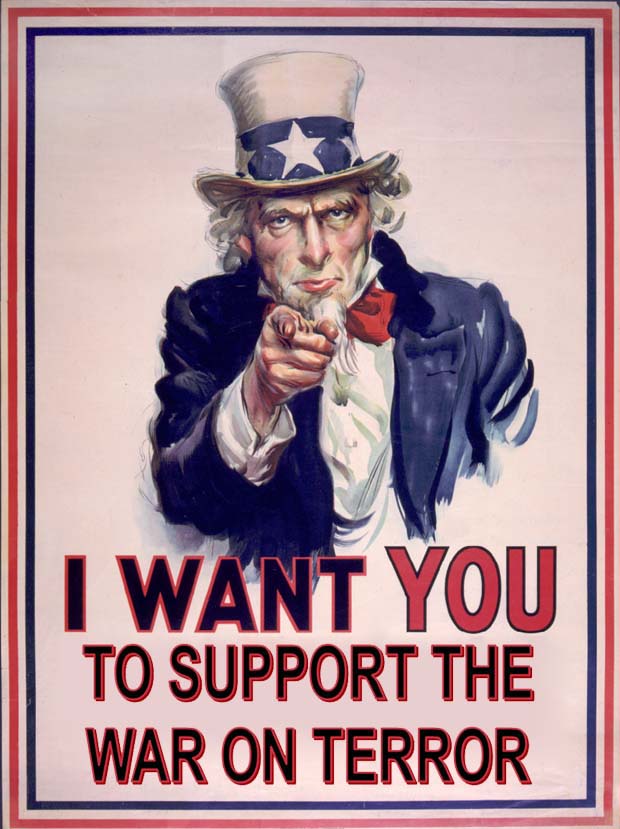
Photo - Uncle Sam (Son of the South)

Saturday, January 24, 2009

Numbers Indicate Former Gitmo Detainees "Return" to Terrorism

The Pentagon last week put out numbers that stated 61 former detainees at the soon-to-be-closed Guantanamo Bay military prison camp have returned to terrorist activities according to U.S. intelligence (the same folks who may or may not have said that Saddam had WMD). Some security experts, however, have come out to say that the number of released Gitmo detainees who "returned" to terrorism may be highly misleading.

For one thing, I wish that the government were just as worried about the recidivism of terrorists as they were of state offenders. The recidivism rate for state prisoners is nearly 70%, which ends up costing the taxpayer untold amounts of money, while 61 former detainees at Gitmo represent only about 11% of the about 520 folks to have pulled a "revolving door" through Gitmo's gates in orange jumpsuits. For example, in 2005 alone 16,692 people were murdered on American streets in non-terror related homicides. Since 1983, terrorism has killed 6,640 (which counts the Beirut bombing, the USS Cole, the Kenyan embassy bombings, Iraq and Afghanistan). If you want to count only terrorist attacks on American soil, the number is 3,315 victims who lost their lives (WTC in '93, Oklahoma City, and 9/11). So while 16,692 people lost their lives in America thanks to domestic crime (whose offenders are, statistically, about 65% likely to commit another crime after spending time in our penal system) in a single year, it is national news (and an outrage that requires immediate attention) when over two decades see 3,315 dead (with only 11% of those likely to recommit terrorist activities). Which is the real national security issue?

Secondly, only 18 of those 61 former detainees have actually been confirmed to be involved in terrorist activities following their release from Gitmo. The other 43 are "suspected" of being involved in terrorist activities. Excuse my cynicism, but I believe that Saddam was "suspected" of being involved with 9/11. So in reality, we know that only 4% of released Gitmo detainees went on to be involved in terrorism. And that's the other thing: if the government says that they "returned" to terrorism, that means that they were involved in it when we picked them up. So if we knew this, how could we not convict them of such a serious charge and send them to prison for life? Is it possible that we picked up innocents who were implicated by their fellow villagers and other shady informants and happened to radicalize them while they were unjustly held without habeas corpus in a military prison on the island of a sworn enemy (Castro)? It does not seem out of the realm of possibilities.

Lastly, the Pentagon has admitted that some of the Gitmo recidivists have been implicated in terrorism for merely making anti-American statements in public. This is to be expected when a country locks you up with no trial, tortures you and deems you to be "the worst of the worst" while keeping you in conditions unfit for a stray dog (all the while, you may not have even done anything). If the only thing that those released from Guantanamo do is publicly make anti-American statements, then we're lucky. Gitmo is a lightning rod for radicalization and terrorist recruitment; Obama is doing this country a favor by closing it down. Think of it like this: a horrible crime occurs in your neighborhood and the cops think it was done by a neighbor. They round up every person in the neighborhood, believing they've caught the guy who did it. They don't bring official charges against anyone and use questionable interrogation techniques. After years of inhumane treatment, they release those that they believe had nothing to do with the crime (who happen to be more than half of all those detained). It turns out that because of the confessions of the man they believe committed the crime were made under torturous conditions, they won't hold up in court so he may get off. Tell me this: how quick would you be to forgive and forget if you were in that neighborhood?

So in summation, the numbers released by the Pentagon days before Obama took office appear to be slightly misleading. Additionally, one could easily make the argument that we have a larger national security issue on our streets thanks to unbelievably high recidivism rates for state offenders. On top of all this, the Pentagon considers those who make statements against the country that tortured and inhumanely (if not illegally) detained them "terrorists." The way I see it is this: if we have the evidence, convict the terrorists, if we do not have the evidence, then how do we know they're terrorists? Unfortunately, thanks to Bush and Co. policies, some legitimate terrorists may have to be let go due to illegal interrogation techniques (or continue to be held illegally). This is America: we pride ourselves on taking the moral high ground; land of the free and home of the brave. It takes much more courage to follow things such as the Geneva Conventions and other internationally agreed-upon rules (and also legally beneficial in the long run) than to sacrifice the freedom of some innocent people halfway across the world and defy the international community. So which path do we choose, bravery or cowardice? Peace.

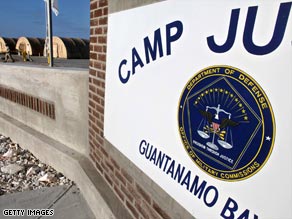
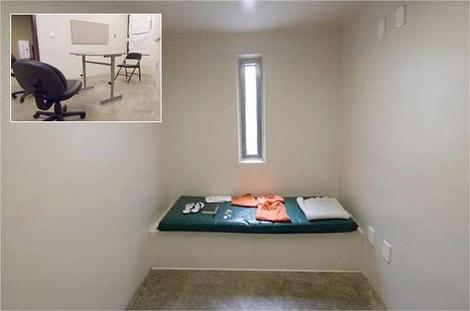
Photos - Camp Justice at Guantanamo Bay (CNN), A cell at Gitmo with a reading room in the inset (Wikipedia)

Friday, November 7, 2008

Habeas Corpus at Gitmo: A Good First Step

In today's New York Times there is an article about the habeas corpus hearings involving Guantanamo detainees that were mandated by the recent Supreme Court decision of Boumediene v. Bush. While this is a good first step and a glimpse of hope for those locked away in the Cuban enclave wrestled from the small Latin nation to our south in the settlement of the Spanish-American War, the hearings themselves are markedly different from anything that would take place on sovereign United States soil.

To begin with, the lawyers for the six Algerian former residents of Bosnia are not allowed to discuss the evidence with their clients. Obviously this greatly hinders the defense's ability to mount a defense for their clients, as they cannot tell their clients what they are being charged with or why. How can someone give an alibi or refute the charges against him without first being told what he did wrong? If the United States is worried that by allowing the defendants to hear/see the evidence against them they will be privy to classified information they previously did not know (such as plans by terrorists to bomb a Sarejevo U.S. Embassy), how airtight is the government's case? If you accuse someone of planning to bomb the embassy, then tell them they cannot see the proof because it may compromise national security - despite the fact that you are accusing that very person with creating the proof (i.e. the plans to bomb the embassy) - then clearly you are not sure beyond a reasonable doubt that this person is guilty and thus should allow him to defend himself in a court of law.

Even more disturbing is the fact that the government has changed their story regarding the six men. They were first accused of planning to bomb the Sarejevo U.S. Embassy, but now the DoJ says that they are being held for other reasons (what other reasons we do not know). Usually when a victim/witness changes their story in the courtroom, they are discredited. Of course, if I were to say that the government has discredited themselves by changing their story in the courtroom, I would be called a terrorist sympathizer, America hater, or, even worse, unpatriotic. Thankfully we have the Patriot Act to make sure that everything I say/do can be tracked and my wireless phone company can hand over private documents without a warrant regarding my phone activity to the government and not be prosecuted, so don't worry America. You're safe from critical thinking and individualism.

The sad fact is, however, that even if these six men are determined to be no threat to the U.S. and are ordered to be released, they won't be going anywhere soon. Back in October the U.S. Court of Appeals for the D.C. District blocked the release of seventeen Chinese Muslims after they were determined to no longer pose a threat to the U.S. and, thus, could not be held as "enemy combatants." Despite federal judge Ricardo M. Urbina's order to release the men, the Bush Administration urged the D.C. Circuit court to have the men remain in custody so the government could rehash their case, which they had just lost. The men remain in custody despite having been ordered to be released.

Guantanamo Bay and the loosely defined and even more loosely designated term "enemy combatant" will be a stain on this country's history similar to the way that Japanese internment was during World War II. Nearly all historians and legal experts would agree that Korematsu v. United States was not only a grave mistake, but embarassing as well. Similarly, the decision to utilize Gitmo to such an extent will prove to be a mistake and will be another moment in U.S. history (hopefully in history and not the future) that shows a grave error on the part of the national leadership at the time. Peace.

Photos - Entrance to Camp Delta at Gitmo (commons.wikimedia.org), Detainees arriving at Camp X-Ray at Gitmo (en.wikipedia.org)