Showing posts with label guantanamo bay. Show all posts

Tuesday, March 29, 2011

Obama Speech on Libya: Close, but No Cigar

By Matt Kane

Last night President Obama addressed the nation about the "kinetic military action" in Libya. In his half hour speech he hit on a few points that should have been made more than a week ago in the lead-up to war in Libya. As I discussed in yesterday's podcast, Obama had his work cut out for him thanks to the horrendous and confusing interview that Secretary of State Clinton and Defense Secretary Gates gave over the weekend on Meet the Press.

One thing that I really liked about the speech was that President Obama came right out and said that the United States led the mission in Libya. I was quite frustrated on Sunday when Clinton said that the United States would be joining the international community, as if the U.S. had not been leading the charge in Libya from the word "go."

One phrase kept popping up in the speech that went directly against what Defense Secretary Gates said on Sunday. Obama said that our "values and interests" are at stake in Libya. That simply is not true. Like Gates said on Sunday, Libya is not in America's vital interest. And talk of values will remain empty as long as Guantanamo is open and Bradley Manning continues to be mistreated. It is akin to Newt Gingrich talking about the sanctity of marriage.

Along the same lines, the whole "stain the conscious of the world" rhetoric is just as empty. If every humanitarian crisis necessitated Western intervention a lá Libya, we would see allied forces on nearly every continent. At the very least we would see a large Western force in places like the Sudans, Zimbabwe, Mexico and Belarus, to name a few. It simply is not realistic.

In all fairness, Obama did bring up other countries going through changes that have been met with violence by the ruling regimes. His answer to this? Libya happened at a very specific time with very specific interests (which, for the record, were not listed) and it differs greatly from other places like Yemen or Syria. Without specifics about what makes Libya different, we would have to take Obama's word that American/allied interests in Libya made it more pressing than other civilian tragedies in other Middle Eastern countries. At this point in his presidency, however, only a fool would take Obama at his word.

Finally, Obama hinted that American and allied involvement in Libya will last much longer than anticipated. Even if Qaddafi steps down, Obama said, Libya will need help and support to transition to a truly democratic nation responsive to its people. This open-ended commitment to democracy in Libya should make anyone who has followed the Iraq War very nervous. Obama praised what we have done in Iraq in terms of bringing them democracy, but in reality we still have about 47,000 troops there. He explicitly stated that regime change is not the goal in Libya, but he wants Qaddafi out. Pick a goal and stick to it, Mr. President. You cannot have it both ways.

Obama made a promise similar to the one he made during this year's State of the Union. He said, "Wherever people long to be free, they will find a friend in the United States." *Offer not applicable in Saudi Arabia, Iran, Yemen, Syria, Bahrain, China or any other country not meeting an unspecified rubric of the United States Department of Defense and Department of State. Unless those seeking freedom feel buoyed by Secretary Clinton's mumblings about restraint and peaceful dialogue while Libyan rebels get first-class Tomahawk missiles and air support, I do not know how valued American friendship will truly be.

Questions or comments? Leave them in the comment section or email The Second Age: admin(at)thesecondageblog.com.

Thursday, January 20, 2011

Amidst Success, Obama's Glaring Failure

As President Obama's approval numbers begin to climb, there is one glaring failure that has taken a back seat to the Giffords shooting and the symbolic vote to repeal "Obamacare" by the House. This failure is one that I have spoken about in the past, ruffling the feathers of many progressives who seem to choose to point to Obama's successes–a watered-down health care bill, a months-too-long repeal of DADT–rather than point out where he can improve.

This failure, of course, is Guantanamo Bay, the blemish of which America seems unable (or worse, unwilling) to rid itself. While Obama promised that Gitmo would be closed within a year of taking office, and signed an executive order to that end, it remains open and fully functional.

If this is not bad enough, Obama has now fully reversed his decision to close Guantanamo by embracing a Bush-era policy of holding military tribunals on the navy base in Cuba. A policy that Obama heavily criticized while running for office in 2008. Back then, he said, "These trials are too important to be held in a flawed military commission system that has failed to convict anyone of a terrorist act since the 9/11 attacks and that has been embroiled in legal challenges." Now he seems more than willing to participate in a process that, by his own words, is a failure.

Sadly, this is not the most disheartening part of all of this. It is the justification used by Republicans that ought to make people hang their head in shame:
While Mr. Ghailani faces between 20 years and life in prison, many Republicans have pointed to his acquittal on 284 related charges — and a judge’s decision to exclude an important witness because investigators learned about the man during Mr. Ghailani’s C.I.A. interrogation — to argue that prosecuting terrorism cases in federal court is too risky.
So the fact that a judge was following the law and not allowing torture-based evidence (the treatment of one detainee who will face a tribunal was so bad that video of it was destroyed by the CIA) means that trying individuals in federal court is too "risky"? This sets a very, very disturbing precedent and the fact that Obama, a lawyer, is going along with it makes it all the more scarier.

And just when you thought it couldn't get worse, it does. On top of all of this, the Obama administration is attempting to rewrite history. The bombing of the USS Cole back in October of 2000 was handled as a peacetime terrorist attack. Because of this, a military tribunal would be an inappropriate venue to charge a suspect because it did not take place during hostilities against al Qaeda, which began after September 11, 2001. What the Obama administration wants to argue is that, according to the New York Times, "a state of armed conflict had legally existed since 1996, when Osama bin Laden declared war against the United States." That would extend the "War on Terrorism" into the first term of Bill Clinton, essentially rewriting history.

To sum up what Obama wants to do: work within a system he's already declared a failure, bow to Republicans who feel following Constitutional principles when trying our enemies is "too risky," and rewrite history to justify all of this. For all of the protests and crying out about George W. Bush's extralegal track record, where is the same outrage for Obama's?

Photo - Gitmo (The Guantanamo Lawyers)

Tuesday, September 28, 2010

Are the Democrats Trying to Lose in November?

I wrote last week on the Huffington Post about how the Tea Party has the potential to energize both the Republican base and the Democratic base this November. The movement is scary, not only from a xenophobic standpoint but also a policy one (or lack of policy), and the prospect of someone like Christine O'Donnell walking the halls of Congress just might be enough to get Democrats out to vote Democratic in an election cycle when, in all honesty, Democrats have not proven themselves worthy of our votes.

Tuesday, October 20, 2009

Open Letter to WSJ

Dear Mr. Editor:

I recently had the trying experience of reading former Attorney General Michael Mukasey's op-ed in your publication on Monday October 19, 2009. To be honest, I expect better from both Mr. Mukasey and your newspaper.

Mr. Mukasey's overall thesis seems to be that we should not try terrorists, specifically those held at Guantanamo, in United States civilian courts because it's hard and we did it in the 1990s and that led to 9/11. Mr. Mukasey uses flimsy examples to back this thesis and leaves the reader wondering how any connection between civilian trials for terrorists led, in any minute way, to the horror this country experienced on September 11, 2001.

One danger Mr. Mukasey points out is the proselytization of individuals behind bars, insinuating that if we do not try terrorists apprehended overseas in civilian courts, the problem will somehow be diminished. As a former Attorney General, Mr. Mukasey should be very familiar with the prison system. To suggest that the type of radical proselytizing he so fears is not occurring currently and will somehow be managed if we do not try terrorists in our own courts is ludicrous. A periphery look at the prison gang system alone tells us that proselytization behind bars is an established institution that will not be effected by the current administration's policy on where to try suspected terrorists.

Then comes Mr. Mukasey's most outrageous statement. He infers that Osama bin Laden did not know that the American government was "aware" of him until he was in possession of the indictment - which listed him as a co-conspirator - stemming from the 1993 World Trade Center bombing. He additionally calls Mr. bin Laden "relatively obscure." Anyone who is familiar with a man named Ronald Reagan should know about the mujahideen, who Reagan called "freedom fighters." One of these "freedom fighters" was Osama bin Laden, who played a major role in the war (during which he founded Al-Qaeda) and returned to his native Saudi Arabia in 1990 as a hero of jihad. To state that Mr. bin Laden must have believed that he was flying under America's radar until he received that indictment, even as he was publicly criticizing Saudi Arabia for its supposed dependence on our nation's military, involves dishonesty, ignorance, or both.

Mr. Mukasey also points to prison violence as a reason to keep suspected terrorists in off-shore custody and to try them in non-civilian courts. He points to the case of a co-conspirator of the Kenya and Tanzania embassy bombings who committed an egregious act of violence against a Bureau of Prisons guard. Prisons are violent places; people are held against their will for running afoul of the law. To suggest that the act of violence Mr. Mukasey portrayed would not have occurred if the prisoner was held elsewhere seems to be off the mark. These are, after all, people accused of killing innocent people for no good reason; if they did, in fact, commit these heinous acts, what is to stop them from being violent behind bars - whether it is here or abroad?

Finally, Mr. Mukasey seems to take exception to the fact that the death penalty was not utilized in the embassy bombings case and that current Attorney General Eric Holder has taken the death penalty off the table for a sixth embassy bombings suspect. Mr. Mukasey looks past the fact the death penalty may not be a very effective deterrent to a group of individuals whose tactics include blowing themselves up to hurt others. Being held in a prison run by the very government you despise and have vowed to destroy, within the same borders of a country you have detested might be a little more ominous than becoming a martyr by being killed by that very same country to hasten your arrival in whatever twisted afterlife scheme you have been made to believe.

Mr. Mukasey says that in return for trying terrorists in civilian courts in the 1990s, our country got the 9/11 attacks. He does not delve into Middle East instability, the United States' covert war in Afghanistan and the proliferation of weapons in the area, or the lack of addressing the power vacuum instigated by the Afghan Civil War as possible precursors to global terrorist activity. Instead he points to trying terrorists in civilian courts in the U.S. during the 1990s as THE reason for 9/11. His op-ed was insulting to its readers who possess a cursory understanding of global history and should have been vetted better by the editorial board. Thank you for your time.

This letter was sent to the Wall Street Journal Opinion Editors on Monday October 19, 2009, the same day that the Mukasey editorial ran

Saturday, January 24, 2009

Numbers Indicate Former Gitmo Detainees "Return" to Terrorism

The Pentagon last week put out numbers that stated 61 former detainees at the soon-to-be-closed Guantanamo Bay military prison camp have returned to terrorist activities according to U.S. intelligence (the same folks who may or may not have said that Saddam had WMD). Some security experts, however, have come out to say that the number of released Gitmo detainees who "returned" to terrorism may be highly misleading.

For one thing, I wish that the government were just as worried about the recidivism of terrorists as they were of state offenders. The recidivism rate for state prisoners is nearly 70%, which ends up costing the taxpayer untold amounts of money, while 61 former detainees at Gitmo represent only about 11% of the about 520 folks to have pulled a "revolving door" through Gitmo's gates in orange jumpsuits. For example, in 2005 alone 16,692 people were murdered on American streets in non-terror related homicides. Since 1983, terrorism has killed 6,640 (which counts the Beirut bombing, the USS Cole, the Kenyan embassy bombings, Iraq and Afghanistan). If you want to count only terrorist attacks on American soil, the number is 3,315 victims who lost their lives (WTC in '93, Oklahoma City, and 9/11). So while 16,692 people lost their lives in America thanks to domestic crime (whose offenders are, statistically, about 65% likely to commit another crime after spending time in our penal system) in a single year, it is national news (and an outrage that requires immediate attention) when over two decades see 3,315 dead (with only 11% of those likely to recommit terrorist activities). Which is the real national security issue?

Secondly, only 18 of those 61 former detainees have actually been confirmed to be involved in terrorist activities following their release from Gitmo. The other 43 are "suspected" of being involved in terrorist activities. Excuse my cynicism, but I believe that Saddam was "suspected" of being involved with 9/11. So in reality, we know that only 4% of released Gitmo detainees went on to be involved in terrorism. And that's the other thing: if the government says that they "returned" to terrorism, that means that they were involved in it when we picked them up. So if we knew this, how could we not convict them of such a serious charge and send them to prison for life? Is it possible that we picked up innocents who were implicated by their fellow villagers and other shady informants and happened to radicalize them while they were unjustly held without habeas corpus in a military prison on the island of a sworn enemy (Castro)? It does not seem out of the realm of possibilities.

Lastly, the Pentagon has admitted that some of the Gitmo recidivists have been implicated in terrorism for merely making anti-American statements in public. This is to be expected when a country locks you up with no trial, tortures you and deems you to be "the worst of the worst" while keeping you in conditions unfit for a stray dog (all the while, you may not have even done anything). If the only thing that those released from Guantanamo do is publicly make anti-American statements, then we're lucky. Gitmo is a lightning rod for radicalization and terrorist recruitment; Obama is doing this country a favor by closing it down. Think of it like this: a horrible crime occurs in your neighborhood and the cops think it was done by a neighbor. They round up every person in the neighborhood, believing they've caught the guy who did it. They don't bring official charges against anyone and use questionable interrogation techniques. After years of inhumane treatment, they release those that they believe had nothing to do with the crime (who happen to be more than half of all those detained). It turns out that because of the confessions of the man they believe committed the crime were made under torturous conditions, they won't hold up in court so he may get off. Tell me this: how quick would you be to forgive and forget if you were in that neighborhood?

So in summation, the numbers released by the Pentagon days before Obama took office appear to be slightly misleading. Additionally, one could easily make the argument that we have a larger national security issue on our streets thanks to unbelievably high recidivism rates for state offenders. On top of all this, the Pentagon considers those who make statements against the country that tortured and inhumanely (if not illegally) detained them "terrorists." The way I see it is this: if we have the evidence, convict the terrorists, if we do not have the evidence, then how do we know they're terrorists? Unfortunately, thanks to Bush and Co. policies, some legitimate terrorists may have to be let go due to illegal interrogation techniques (or continue to be held illegally). This is America: we pride ourselves on taking the moral high ground; land of the free and home of the brave. It takes much more courage to follow things such as the Geneva Conventions and other internationally agreed-upon rules (and also legally beneficial in the long run) than to sacrifice the freedom of some innocent people halfway across the world and defy the international community. So which path do we choose, bravery or cowardice? Peace.

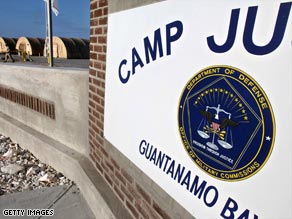
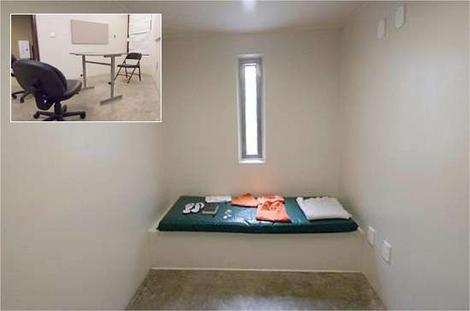
Photos - Camp Justice at Guantanamo Bay (CNN), A cell at Gitmo with a reading room in the inset (Wikipedia)

Thursday, January 22, 2009

Obama to World: I Am Breaking with Bush Policies

Today Obama signed a significant executive order that states the controversial just-out-of-constitutional-jurisdiction Guantanamo Bay military prison will close no later than a year from today, among other incarceration- and interrogation-related orders left over from the Bush Administration. What this primarily does is send the message that a new dawn has arisen in the war on terror and the use of controversial techniques and absolute secrecy will slowly fade out. The decision has been hailed both at home by Democrats, others who have read the Constitution and leaders abroad.

Obama has pledged to go through each detainee's files (which seem to have been ill-kept under the Bush Administration) and decide which detainees are releasable, triable, and untriable. A detainee may be untriable for a number of reasons, such as lack of evidence (this is where we can see the habeas corpus violations) or the use of torture to obtain confessions and other evidence (thanks to the previous administration). Another important aspect of the executive order is the assertion that the U.S. and its intelligence agencies use only the non-coercive techniques laid out in the Army Field Manual, rather than the SERE techniques being used at Gitmo and other CIA black sites.

Why is this logical? There are many reasons, but one of the main ones is that it is morally right. No one should be tortured, never mind at the hands of the most powerful country in the world that has timelessly claimed to take the moral high ground. Secondly, torturing folks is not the way to win the "hearts and minds" of those folks at risk to become extremists. In fact, images from Abu Ghraib have been used to recruit terrorists. And imagine being detained without trial for something you did not do. When you're released, are you going to defend your captor when others are angry with them? Sure, you were innocent before Bush came along and rounded you up and threw you in a cage, but that sure pissed you off and now you want death to America. Places like Guantanamo do not make America safer in the long run; in fact, they threaten our national security severely.

And Obama's decision to close Gitmo is no knee-jerk reaction to the misguided policies of the Bush Administration, despite what some Republican leaders may say (more on those folks later). Obama admits that there are some dangerous people at Gitmo who are not triable because of a lack of evidence and the allegations of torture used to obtain evidence against them. It seems that these accused terrorists will not be freed until a plan is devised to deal with them. So while they may not be housed at Gitmo, they aren't going anywhere soon.

So what do many high-profile Republicans think of this? Peter Hoekstra of Michigan (ranking Republican on the House Intelligence Committee) said that the decision to close the prison within a year "places hope ahead of reality — it sets an objective without a plan to get there." House Majority Leader John Boehner (R-Ohio) said, "The big concern is, how do you come up with a policy to say, ‘We're going to close Guantanamo,’ without having a policy in place for what you're going to do with those that are there?" These two decry a lack of a plan (something Obama has acknowledged and made clear that those accused terrorists deemed dangerous to the U.S. but untriable will not be released), yet both voted for the Iraq War, a war that many have come out and said was poorly managed and had no coherent plan from the get-go. So let me get this straight: Hoekstra and Boehner have no problem allowing a Republican to lead us into Vietnam II that is the Iraq quagmire, yet throw their hands up in protest when a Democrat tries to close the torturous prisons that have so hurt America's stature in the world. Also keep this in mind: Bush stated that he was the "decider" and gave a facade of omnipotence when it came to Iraq and war strategy while Obama has come out and said that decisions have to be made on what to do with the untriable detainees and nothing brash will occur before those decisions are made (and also does not have Nixon cronies making said decisions for him). I guess I am looking for Hoekstra's and Boehner's credibility and failing to find it.

In all, Obama's executive order makes it clear that the Bush Administration's policies of torture and incarceration without trial is coming to a close. Many Bush supporters say that history will treat 43 well and we will look back on this in 25 years and say, "Wow, Bush had foresight." I disagree. Gitmo will be viewed like the Japanese internment of WWII, Iraq will be viewed like Vietnam is today, when all the behind-the-scenes information comes out in the next few decades Bush will be seen as the second coming of Nixon (hell, half his staffers were Nixon's anyway), and Bush's number one accomplishment will be declaring war on an ideology. Guantanmo Bay will (hopefully) be closed a year from today and America will be safer in the long run for it. Peace.

Photos - Obama signing the executive order declaring that Gitmo will be closed a year from today (New York Times), Detainees at Guantanmo Bay, Cuba (Washington Post)

Friday, November 7, 2008

Habeas Corpus at Gitmo: A Good First Step

In today's New York Times there is an article about the habeas corpus hearings involving Guantanamo detainees that were mandated by the recent Supreme Court decision of Boumediene v. Bush. While this is a good first step and a glimpse of hope for those locked away in the Cuban enclave wrestled from the small Latin nation to our south in the settlement of the Spanish-American War, the hearings themselves are markedly different from anything that would take place on sovereign United States soil.

To begin with, the lawyers for the six Algerian former residents of Bosnia are not allowed to discuss the evidence with their clients. Obviously this greatly hinders the defense's ability to mount a defense for their clients, as they cannot tell their clients what they are being charged with or why. How can someone give an alibi or refute the charges against him without first being told what he did wrong? If the United States is worried that by allowing the defendants to hear/see the evidence against them they will be privy to classified information they previously did not know (such as plans by terrorists to bomb a Sarejevo U.S. Embassy), how airtight is the government's case? If you accuse someone of planning to bomb the embassy, then tell them they cannot see the proof because it may compromise national security - despite the fact that you are accusing that very person with creating the proof (i.e. the plans to bomb the embassy) - then clearly you are not sure beyond a reasonable doubt that this person is guilty and thus should allow him to defend himself in a court of law.

Even more disturbing is the fact that the government has changed their story regarding the six men. They were first accused of planning to bomb the Sarejevo U.S. Embassy, but now the DoJ says that they are being held for other reasons (what other reasons we do not know). Usually when a victim/witness changes their story in the courtroom, they are discredited. Of course, if I were to say that the government has discredited themselves by changing their story in the courtroom, I would be called a terrorist sympathizer, America hater, or, even worse, unpatriotic. Thankfully we have the Patriot Act to make sure that everything I say/do can be tracked and my wireless phone company can hand over private documents without a warrant regarding my phone activity to the government and not be prosecuted, so don't worry America. You're safe from critical thinking and individualism.

The sad fact is, however, that even if these six men are determined to be no threat to the U.S. and are ordered to be released, they won't be going anywhere soon. Back in October the U.S. Court of Appeals for the D.C. District blocked the release of seventeen Chinese Muslims after they were determined to no longer pose a threat to the U.S. and, thus, could not be held as "enemy combatants." Despite federal judge Ricardo M. Urbina's order to release the men, the Bush Administration urged the D.C. Circuit court to have the men remain in custody so the government could rehash their case, which they had just lost. The men remain in custody despite having been ordered to be released.

Guantanamo Bay and the loosely defined and even more loosely designated term "enemy combatant" will be a stain on this country's history similar to the way that Japanese internment was during World War II. Nearly all historians and legal experts would agree that Korematsu v. United States was not only a grave mistake, but embarassing as well. Similarly, the decision to utilize Gitmo to such an extent will prove to be a mistake and will be another moment in U.S. history (hopefully in history and not the future) that shows a grave error on the part of the national leadership at the time. Peace.

Photos - Entrance to Camp Delta at Gitmo (commons.wikimedia.org), Detainees arriving at Camp X-Ray at Gitmo (en.wikipedia.org)