In a horrifying follow-up to my last post, evangelical conservatives in positions of power have once again breached the barrier between government and education. According to the Times, seven fundamentalist right-wingers on the Texas Board of Education have added a slew of changes to the state's textbook curriculum, including amendments to pedagogy on government, history, and sociology.
Unsurprisingly, as we find ourselves in a hyperpartisan political atmosphere countrywide, government officials have actually summoned the audacity to make changes to educational standards that shine capitalism, small government, conservative values, and the conflation of government and religion, in a more positive light. They hide their reprehensible political agenda behind the often repeated (by right-wingers with a political agenda) notion that American education is "skewed toward the left."
In a similar vein, Tucker Carlson recently attacked American colleges and universities on Fox News as bastions of biased liberal thought. His analysis of the report to which the segment refers is fallacious, and the entire clip is essentially just conservatives feeding off each other's contempt for liberalism. These strategies of claiming bias in places where bias does not exist in order to bolster one's own political agenda are sinister, but they are also clever and will likely prove effective in the long run.
The "tea party" movement is not only a backlash against hyperbolic visions of big government takeovers; ironically, it has manifested itself as a big government takeover of its own, trying to use political power to instill certain political values in Americans from an early age. When party-line democratic votes like the one in Texas are able to fundamentally change the way children view history, we must take a step back and question the efficacy of our system of government and our intellectual freedoms. Once government begins to tweak the way history is taught, where do we draw the line between our free democracy and propaganda-riddled, freedom-constrained governments such as China's?

Showing posts with label conservative. Show all posts
Showing posts with label conservative. Show all posts
Sunday, March 14, 2010


Wednesday, September 9, 2009
Conservatives Attack, Democrats Say Uncle
In November 2008, an already majority-Democrat Congress made further gains in both the House of Representatives and the Senate, and won the presidency as well. Now, with a relatively progressive House and a nominally "filibuster-proof" majority in the Senate, it would be logical that the legislative agenda in Washington would be tilted in favor of more progressive policies. And the White House has certainly taken some bold steps over the past eight months, including addressing issues from Guantanamo Bay to Vehicle Emissions Standards. And yet, compared to how much progress should have been made by now, it seems that conservatives have been particularly successful in stymieing a great deal of what could have been accomplished.
 Since the Democrats took control of both branches, conservatives and the vast majority of the Republican party (see the breakdown of House votes on the Stimulus bill) have employed a clever strategy in Washington; namely, to obstruct everything Democrats try to do. And in large part, it's worked well. With the help of incendiary pundits pushing their agendas on the airwaves, conservatives have been able to drive their messages into the hearts of Americans, though not necessarily by explaining why their policy ideas are stronger than those of Democrats.
Instead, most "calls to arms" from the right have been predicated on somewhat or outright misleading information. Town hall meetings have been overrun by angry citizens who think the health care reform means a socialist takeover of the health care system and "death panels." Obama's speech yesterday on how kids should stay in school and work hard caused a massive controversy in the preceding weeks over whether the President was trying to "indoctrinate our youth" with "socialist ideas," and Van Jones was forced to resign from the Council for Environmental Quality because of vicious attacks on his character from right-wing pundits and Republican Congressmen.
 It turns out Obama's speech on the first day of school was about taking personal responsibility and working hard (aren't those the core tenets of American conservatism?). And yet, after hearing Glenn Beck rant about Obama's socialist motives on Fox News, enraged and frightened parents demanded that their children not be subjected to such a speech. Conservatives are so effective at getting their political agenda across that they have actually been able to convince parents not to let their kids listen to speeches about the values of education and hard work by the President of the United States of America, just because he is a Democrat. Now that is impressive. And appalling.
 Meanwhile, Van Jones resigned late Saturday from his position as Special Advisor for Green Jobs, Enterprise, and Innovation at the White House Council on Environmental Quality. A few weeks earlier, a non-profit that Jones had founded, Color of Change, organized an advertising boycott of Beck's Fox News show after the demagogue called Obama a "racist." In retaliation, Beck began an all-out smear campaign on Jones's character, stirring public fears of Obama's non-Senate-confirmed "czars" (somehow the idea of Russian monarchs giving Obama advice is especially terrifying). Now Jones, who is a visionary, an activist, and a true patriot, can no longer help serve his country in transitioning us to a socially equitable, clean energy economy.
All these controversies and distractions have helped to keep the President's and Democrats' agenda largely on hold. And Democrats and progressives don't seem very capable at fighting back on any of these issues. Glenn Beck, now seemingly one of the most powerful people in the US, has instilled fear in Americans, enhanced distrust in Democrats, and put them on the defensive instead of where they should be—passing key legislation. Even with big majorities in both Houses, Democrats are being out maneuvered by Republicans and conservatives at every turn, and are squandering rare and precious opportunities for changes that our country desperately needs.
Images: Obstructionist cartoon (Rockford Register Star), Glenn Beck (Grist), Van Jones (Washington Post)
Friday, July 10, 2009
The Problems with Democracy I
 A new study by the Pew Research Center shows that there is a vast disconnect between the views of American scientists and the American public. Only about half of the public agrees that climate change is caused by humans, and 11 percent believes climate change doesn't exist at all. About one third of Americans believe there is still an ongoing debate on the subject. Meanwhile, nearly all scientists believe that human activity is directly related to climate change.
Many in the scientific community acknowledge that they have not done enough, and scientists in general do not do enough, to actively engage the public with regard to their research and findings. The media also deserves some blame for focusing too much on "both sides" of issues, instead of on objective expertise. But ultimately, scientists tend not to have any more say in public policy than anyone else, and in many cases, are largely overlooked or ignored.
The notion of American democracy is predicated upon the will of the people. And though it is not always the people who in fact have their will carried out (I'll touch on this in a later post), it is clear that the will of the people—the laypeople, if you will—is not necessarily the most logical, utilitarian, or even remotely beneficial drive for public policy. Indeed, the average person is caught up in their own narrow context within society (How much money will this cost me? How does this benefit me? Why should I care?).
One of the biggest selling points for conservatism is its championship of low taxes. And don't get me wrong; I don't like paying taxes either, and I happen to think there is a huge amount of government spending that is unnecessary, wasteful, and even harmful. But many Republican politicians capitalize on Americans' general attitudes by justifying our seemingly innate selfishness with their tirades against spending—even on programs that will ultimately serve to benefit far more people in the long run (e.g. universal health care).
 Americans don't want to be taxed and don't want to have our money taken away. Americans don't want "government standing between you and your doctor," and don't want to have to pay more for the energy we consume. And so it makes sense that politicians exploit these widespread aversions. But this black and white idea of government staying out of our business and leaving us and our money alone simply doesn't make sense. In a world where no perfect market exists, it is government's responsibility to protect consumers, provide people with basic services that everyone should be entitled to (education, health care, public safety, etc.), and address negative externalities that affect citizens who would otherwise not be able to defend themselves.
When people are thinking strictly about their wallets—in part because politicians and the media are only fanning the flames of citizens' all-too-narrow perspectives of public policy—it serves to undermine the well being of society as a whole. Americans too often don't possess the wherewithal to make sound judgments about what policies would be best for them and the country as whole, especially in the long run.
And this doesn't even account for the increasingly frightening reality that people outside of the US are greatly affected by our activities. In the case of climate change, the people who are most vulnerable to losing their livelihoods, largely because of our country's exorbitant consumption habits, have absolutely no voice—within the context of our narrow Westphalian nation-state democracy—to be able to enact or even influence any changes.
 The idea of the "perfection" of republican democracy is still hotly debated. People with no expertise or far-reaching knowledge about most subjects elect representatives—often for reasons that have little or nothing to do with policy initiatives—who are meant to serve the needs and wants of their constituents (and often exploit constituents' fears and selfish tendencies to maintain their own power). Policymakers and their advisers are too often far disconnected from the scientific community, and see no political advantage to seeking expert advice. Meanwhile, their policies can affect Americans and non-Americans alike who are unable to influence the political process at all. Modern democracy has serious flaws that continue to go unaddressed today.
Then again, as Winston Churchill once said, "Democracy is the worst form of government, except all the others that have been tried." Benevolent dictatorship, anyone?
Images: Statue of Liberty (wayfaring.info), taxes (justinperry.net), Julius Caesar (tqnyc.org)
Monday, June 15, 2009
RIght-Wingers vs. Right-Wingers
Frank Rich had a very insightful op-ed in the Times yesterday on the hatred that percolates from the right wing in the United States. Indeed, while conservative policies are often deleterious to average Americans, we find huge swaths of support for such policies in public polls, thanks largely to the masterful messaging of political conservatives, messages often predicated upon fear and hatred.
 Recently, conservatives have evoked the notion of progressive policies being similar to the policies of Hitler, in an ironic twist of logic. And lo and behold, we find the same sort of demagoguery coming from Iranian president Mahmoud Ahmadinejad, who is attributing "Hitler-style techniques" to his political rivals. It is no coincidence that conservatives in the United States and conservatives in Iran are using similar tactics to manipulate their electorates. They are both understandably successful at garnering support after using such fear-inducing language (I still find it painfully hypocritical, though, that Ahmadinejad evokes Hitler as an epitomization of evil while continuing to deny the Holocaust).
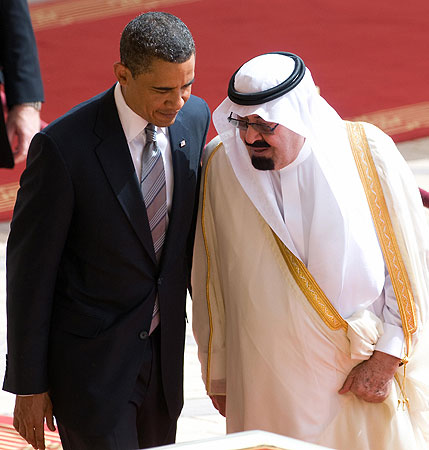
One glaring consequence of this extremist conservatism is that as it intensifies and gains influence, in whatever country, it makes the world a more hate-filled and consequently dangerous place. Since his groundbreaking speech in Cairo, Obama has been barraged by conservatives as being too "apologetic" to the Muslim world. In his speech, however, he not only made no semblance of an apology, but addressed the need for Middle Eastern nations to reject authoritanism and establish true democracies, governmental shifts that would serve to weaken the hate-mongering right wing extremists in those countries. Yet the analogous extremists in the United States, who purport to cherish freedom and democracy, decry the President for his less-than-hawkish tone, calling him weak and ultimately harmful for America.
 As these extremists convince their fellow citizens to elect politicians who espouse their views—as they have in the cases of George W. Bush, Vladimir Putin, Ahmadinejad, and recently Benjamin Netanyahu and Avigdor Lieberman in Israel—the inflammatory tone in each of these countries is increasingly amplified, until a tipping point is reached. In the case of Israel and Iran, frighteningly enough, that tipping point could come in the form of war, and even nuclear war.
Politicians like Obama, who are wise to strike a more tempered tone, help to ease some of the tensions, anger, and hatred that can so easily be tapped for political gain. While Obama may receive criticism for his words, he is ultimately making the world a more peaceful place. He is helping to avoid the unnecessary violence brought about by right-wingers who, in their hatred for right-wingers in other nations, engage in an arms race, both figuratively and literally, sending the level of discourse spiralling downward and increasing the propensity for confrontation and war. Too often, people believe that the only way to deal with incendiary leaders like Ahmadinejad is to elevate incendiary leaders of our own. But maybe the path to world peace is by backing away from the "tough guy" persona and actually engaging our supposed enemies.
Images: Mahmoud Ahmadinejad (truthdig.com), nuclear warhead (howstuffworks.com), Obama in Egypt (publicradio.org)
 Recently, conservatives have evoked the notion of progressive policies being similar to the policies of Hitler, in an ironic twist of logic. And lo and behold, we find the same sort of demagoguery coming from Iranian president Mahmoud Ahmadinejad, who is attributing "Hitler-style techniques" to his political rivals. It is no coincidence that conservatives in the United States and conservatives in Iran are using similar tactics to manipulate their electorates. They are both understandably successful at garnering support after using such fear-inducing language (I still find it painfully hypocritical, though, that Ahmadinejad evokes Hitler as an epitomization of evil while continuing to deny the Holocaust).
One glaring consequence of this extremist conservatism is that as it intensifies and gains influence, in whatever country, it makes the world a more hate-filled and consequently dangerous place. Since his groundbreaking speech in Cairo, Obama has been barraged by conservatives as being too "apologetic" to the Muslim world. In his speech, however, he not only made no semblance of an apology, but addressed the need for Middle Eastern nations to reject authoritanism and establish true democracies, governmental shifts that would serve to weaken the hate-mongering right wing extremists in those countries. Yet the analogous extremists in the United States, who purport to cherish freedom and democracy, decry the President for his less-than-hawkish tone, calling him weak and ultimately harmful for America.
 As these extremists convince their fellow citizens to elect politicians who espouse their views—as they have in the cases of George W. Bush, Vladimir Putin, Ahmadinejad, and recently Benjamin Netanyahu and Avigdor Lieberman in Israel—the inflammatory tone in each of these countries is increasingly amplified, until a tipping point is reached. In the case of Israel and Iran, frighteningly enough, that tipping point could come in the form of war, and even nuclear war.
Politicians like Obama, who are wise to strike a more tempered tone, help to ease some of the tensions, anger, and hatred that can so easily be tapped for political gain. While Obama may receive criticism for his words, he is ultimately making the world a more peaceful place. He is
 helping to avoid the unnecessary violence brought about by right-wingers who, in their hatred for right-wingers in other nations, engage in an arms race, both figuratively and literally, sending the level of discourse spiralling downward and increasing the propensity for confrontation and war. Too often, people believe that the only way to deal with incendiary leaders like Ahmadinejad is to elevate incendiary leaders of our own. But maybe the path to world peace is by backing away from the "tough guy" persona and actually engaging our supposed enemies.
Images: Mahmoud Ahmadinejad (truthdig.com), nuclear warhead (howstuffworks.com), Obama in Egypt (publicradio.org)
Tuesday, January 6, 2009
Uncertainty About the Middle East Conflict
There are lots of issues that I have no problem speaking out about, like the ones I’ve covered so far in my posts. Then there are others, like abortion or illegal immigration, about which I don’t feel confident enough in my opinions to assert them publicly. One of these issues is the ongoing conflict in the Middle East, which has escalated to warfare in the past week.
 This Israeli-Palestinian conflict has always been a sticky one for me, especially being a Jew and being conditioned in Hebrew school from a young age to believe in everything Israel without a second thought. It seems like the more “liberal” take on the conflict is a more peace-oriented one, calling for a two-state solution, for Israel to withdraw from settlements in the Gaza strip and the West Bank, and for Israel to maintain peace with the Palestinians, including Hamas-controlled Gaza, no matter what the circumstances.
Then there are the more traditionally “conservative” arguments, which seem to devote unconditional support to Israel, being the sole free-trading, America-loving democracy in the Middle East (and it’s not an Arab or Muslim country, to boot). And now, with Bush’s presidency drawing to a close, Israel may in fact be undertaking this military offensive while they know they still have a staunch ally at the helm in the US, with Obama claiming to be a strong supporter, but his true convictions on the matter being yet untested.
 Hearing about all the Palestinian civilians who have been killed and injured is heartbreaking. And with so few Israelis having died on the other end, it’s not surprising that there have been protests worldwide (including in New York on Saturday) against Israel’s aggression, as well as some pretty damning press. While Israeli spokespeople claim that Israel is doing everything it possibly can to avoid civilian casualties and only hit Gaza in militarily strategic areas, there have been hospitals, schools, and mosques hit by airstrikes, and dozens, if not hundreds, of civilians killed.
 The Israeli argument centers around Hamas’s rockets that have been launched into Israel fairly incessantly over the past several weeks and months, even during the cease fire. Children living in Israeli towns near the Gaza strip, as my friend Leo has recently seen firsthand, are experiencing a constant fear and panic as to where and when the rockets will hit next. If the United States were at the receiving end of rocket fire from Mexico, you can bet your life that our army would be in there in no time to carry out whatever operation was necessary to cease any further attacks. Is that a bad thing, as many liberals might contend? In that instance, should we be strictly seeking diplomatic negotiations, and not getting our military involved? Is it a flaw of Israel’s and the United States’ that our solution to violence is a robust militaristic response?
This is where I’m not sure how I feel. American Jews tend to be more in tune with Israel’s response because they feel connected to the land and can empathize more easily with the Israeli people, just as any American, even most liberals, I would guess, would support military action in response to the Mexico scenario. But war is never a positive thing, and so I cringe when I find myself tacitly approving of it.
Still, for many in the Arab world (and elsewhere), the conflict has less to do with the current hostilities and more to do with Israel’s fundamental right to exist. That is a completely different discussion, and one that I don’t think is relevant to finding a solution to what is happening right now. But no matter who is right and who is wrong, I hope the fighting ends as soon as possible. No one deserves the fate, or even the fearful lives, that countless Palestinians and Israelis are experiencing.
I’d love to hear what you have to say. Please comment.
Photos: Israeli soldier (Associated Press), Palestinians carrying injured man (BBC), Israel Map (State Department)
This Israeli-Palestinian conflict has always been a sticky one for me, especially being a Jew and being conditioned in Hebrew school from a young age to believe in everything Israel without a second thought. It seems like the more “liberal” take on the conflict is a more peace-oriented one, calling for a two-state solution, for Israel to withdraw from settlements in the Gaza strip and the West Bank, and for Israel to maintain peace with the Palestinians, including Hamas-controlled Gaza, no matter what the circumstances.Then there are the more traditionally “conservative” arguments, which seem to devote unconditional support to Israel, being the sole free-trading, America-loving democracy in the Middle East (and it’s not an Arab or Muslim country, to boot). And now, with Bush’s presidency drawing to a close, Israel may in fact be undertaking this military offensive while they know they still have a staunch ally at the helm in the US, with Obama claiming to be a strong supporter, but his true convictions on the matter being yet untested.
 Hearing about all the Palestinian civilians who have been killed and injured is heartbreaking. And with so few Israelis having died on the other end, it’s not surprising that there have been protests worldwide (including in New York on Saturday) against Israel’s aggression, as well as some pretty damning press. While Israeli spokespeople claim that Israel is doing everything it possibly can to avoid civilian casualties and only hit Gaza in militarily strategic areas, there have been hospitals, schools, and mosques hit by airstrikes, and dozens, if not hundreds, of civilians killed.
 The Israeli argument centers around Hamas’s rockets that have been launched into Israel fairly incessantly over the past several weeks and months, even during the cease fire. Children living in Israeli towns near the Gaza strip, as my friend Leo has recently seen firsthand, are experiencing a constant fear and panic as to where and when the rockets will hit next. If the United States were at the receiving end of rocket fire from Mexico, you can bet your life that our army would be in there in no time to carry out whatever operation was necessary to cease any further attacks. Is that a bad thing, as many liberals might contend? In that instance, should we be strictly seeking diplomatic negotiations, and not getting our military involved? Is it a flaw of Israel’s and the United States’ that our solution to violence is a robust militaristic response?
This is where I’m not sure how I feel. American Jews tend to be more in tune with Israel’s response because they feel connected to the land and can empathize more easily with the Israeli people, just as any American, even most liberals, I would guess, would support military action in response to the Mexico scenario. But war is never a positive thing, and so I cringe when I find myself tacitly approving of it.
Still, for many in the Arab world (and elsewhere), the conflict has less to do with the current hostilities and more to do with Israel’s fundamental right to exist. That is a completely different discussion, and one that I don’t think is relevant to finding a solution to what is happening right now. But no matter who is right and who is wrong, I hope the fighting ends as soon as possible. No one deserves the fate, or even the fearful lives, that countless Palestinians and Israelis are experiencing.
I’d love to hear what you have to say. Please comment.
Photos: Israeli soldier (Associated Press), Palestinians carrying injured man (BBC), Israel Map (State Department)
Subscribe to:
Posts (Atom)