Showing posts with label marc cooper. Show all posts

Wednesday, July 28, 2010

Sean Bell Settlement Reached for $7 Million of Taxpayer Money

The family and friends of Sean Bell will receive more than $7 million from the city stemming from the shooting of Bell and his two friends, Joseph Guzman and Trent Benefield. The settlement is a large one, but it doesn't beat out the settlement reached last month in the case of Barry Gibbs, a man who spent 19 years behind bars after being framed by an NYPD detective for murder. Gibbs will receive $9.9 million from the city.

So who pays the $17 million for police malfeasance? You and I do, of course. Despite the fact that we know who pulled the triggers that killed Bell and injured his friends - Marc Cooper, Gescard Isnora (who fired the first shot), and Michael Oliver (who fired 31 shots, requiring a magazine change) - none of these men will be contributing to the $7 million settlement. This is also not the first time Michael Oliver has cost the city more money than he's worth: in 1995 Oliver shoved a livery cab driver's head into a car window, resulting in a $10,000 settlement to the victim. Somehow Oliver kept his job so he could later cost the city even more money in the Bell case.

Wednesday, April 30, 2008

Sean Bell's Killers Can Still Face Justice

While Judge Arthur T. Cooperman's verdict of not guilty on all charges last week for Detectives Michael Oliver, Gescard Isnora, and Marc Cooper, the feds seem to be slightly interested in the case. Representative John Conyers (D-MI), the chair of the House Judiciary Committee, met with Bell's family and his two friends injured the melee, Trent Benefield and Joseph Guzman, promising a close look at the case. A federal case being taken up after an acquittal in a state case would not be unprecedented, as Francis X. Livoti - a former NYPD officer - was acquitted of choking a Bronx man, Anthony Baez, to death by a state court, but was later convicted of violating Baez's civil rights by a federal court. Livoti was found to have killed Baez, lied to cover it up, and solicited the help of fellow officers to lie and help cover up the case. He was sentenced to 7 1/2 years in a federal pen. Even before the federal case, Livoti was fired from the force for using the illegal chokehold on Baez, who died in and incident apparently started when a football being used in a family game hit a police cruiser. What is important to note with Livoti's case is that the state judge who acquitted him used similar language as Judge Cooperman. While Livoti's judge said that Livoti was not innocent, the prosecution merely failed to prove his guilt beyond a reasonable doubt. Judge Cooperman, in his decision, pointed out that things like carelessness and incompetence were not to be decided in his court, leaving open the door for "other forums" (i.e. the feds).

What seems to be certain is that none of the six detectives involved in Sean Bell's killing that night (Detectives Oliver, Isnora, Cooper, and Officer Michael Carey, Detective Paul Headley, and the commanding officer that night Lieutenant Gary Napoli (the only officer not to shoot, which is saying something seeing he was the commanding officer)) will never carry a gun and a badge for the NYPD again (thankfully). The Times quotes officials as saying that none of them can reasonably expect to do so. This is not unprecedented, however, as we saw with Livoti earlier. Taking a look at another case shows the same outcomes. The four officers involved in the Amadou Diallo case no longer carry guns for the NYPD - three left and one (Kenneth Boss) is not allowed a firearm, though he is fighting to get one back. So even if Ray Kelly allows the trigger-happy cops to stay on the force, it would most likely be in a severely limited capacity with no firearms involved, which is a relief for unarmed black men across the city.

As far as the feds picking up the case, it's certainly possible. If Livoti's case in the death of Anthony Baez is any indication, the feds have certainly set precedents to bring justice for victims of police killings. However, it is also important to note that Amadou Diallo's murderers (which I view as a much more egregious case) never faced a federal trial. That's why I think this could go either way. While I will be upset if the feds do not bring charges, I cannot say that I will be entirely surprised. One of the main things I am looking towards, however, is Judge Cooperman's language referring to the "recklessness and carelessness" of the officers, which could result in civil rights charges (plus it is similar to language used by the acquitting judge in Livoti's case). In any event, it is slightly (very slightly) comforting that these men will never carry guns under the charge of the NYPD and hopefully will not serve the NYPD in any capacity in the future. Peace.

Photos - Michael Oliver, Gescard Isnora, Marc Cooper (l-r) (serenitylife.vox.com), Sean Bell (www.nydailynews.com), A good question (dearkitty.blogsome.com)

Friday, April 25, 2008

Setting Dangerous Precedents: Sean Bell's Killers Acquitted

It's Amadou Diallo part II: Sean Bell's killers have been acquitted of shooting 50 rounds at Bell and his friends on that fateful night back on November 25, 2006. At the conclusion of the bench trial requested by the defendants (who, apparently, did not trust the very people that they have pledged to protect and to serve), Judge Arthur T. Cooperman declared that all three men charged (despite the fact that there were five officers involved in the incident) did not act in a criminal manner when they killed Sean Bell and wounded his friends, all of whom were unarmed. Adding insult to injury, Judge Cooperman said that the testimony of Bell's friends at times did not make sense.

Numerous questions have to be asked about this case and its conclusion. What kind of precedent does this set for the NYPD and victims of police violence? First Amadou Diallo's killers get off the hook (following a dubious move to Albany - a much whiter city than New York) after firing 41 shots at the African immigrant, and now Sean Bell's killers, after firing 50 shots, are also off the hook. What is interesting is that with previous NYPD killings, while those officers involved were acquitted of criminal charges, large monetary settlements were given to the families of the victims. Amadou Diallo's family received $3 million, Patrick Dorismond's family got $2.25 million, and Timothy Stansbury's family received $2 million. I would be highly surprised if Bell's family did not receive some sort of compensation for their loss at the hands of the police department. But this begs the question: if the justice system thinks that these officers did nothing wrong, why settle with the families? By giving someone money (which is a shitty substitute for seeing those who killed your loved one put to justice), are you not admitting wrongdoing? If the NYPD is just doing what they're trained to do by gunning down these unarmed black men, then why pay the families of those who obviously had to be doing something wrong to get such a violent response from these trained officers?

I also want to go back to a case that I discussed a little over a year ago that occurred in Rhode Island. A corrections officer named Dante Pingitore was scoring some coke in Providence when he was approached by state police. Pingitore, in response to this, "rammed" his car into an unmarked police cruiser with officers inside. Pingitore could assumed to be armed, because he was a corrections officer for his state, yet his showdown with cops was resolved without firing a single shot. The interesting thing about this case (in case you could not figure it out from his Italian name) Pingitore is, by all available evidence short of an actual photo, white. If Rhode Island cops can prevent violence in a nearly carbon-copy case of Sean Bell's, why can't the NYPD? Does this mean that the NYPD is less trained or worse at their job than Rhode Island troopers? No two cases are the exact same, but these two cases are very similar and it should be noted that one ended with a person being given paid leave and bail and the other being buried.

Other questions that seem to remain unanswered: if the officers present that night were so certain that Bell and his friends not only had a gun, but were psychics and knew that Bell and his friends would go back to their car to get said gun and commit a drive-by (maybe the cops are related to Ms. Cleo?), why allow them to get into the car? Was it an example of NYPD brinksmanship? Why did Gescard Isnora open fire? Did he see a gun, or was he just going off of the equivalent of a middle-school rumor (well, someone said it, so it must be true)? Maybe he saw one of the victims' hands and took a page out of Sean Sawyer's playbook. It is amazing how the defense portrayed the whole thing as Joseph Guzman's (one of Bell's friends) fault. They said that because Guzman told Bell to go as Isnora approached the car, he caused all of this. Let's kick some logic for a moment: you just got into an argument with a group outside of a strip club and then some guy approaches your car with a gun drawn. Are you going to stick around to see what happens? Hell no. (Quick note: Isnora said that he clipped his badge to his collar and yelled "police." It was the middle of the night in November, so the car windows were probably closed, and thus they would not have heard Isnora's shout or seen his badge, if he even did this, as witnesses say that Isnora neither yelled police or had his badge visible.) So without seeing a gun or confirming the presence of any kind of weapon, Detective Isnora fired the first shot, leading to 49 more shots from him and his colleagues.

The most ridiculous part of this entire case is probably the role of Detective Michael Oliver - the man who shot 31 shots at Bell and his companions. Now you might be saying to yourself "Wow, I didn't know that the department-issued glocks had banana clips that held so much ammunition." Well, they don't. Oliver emptied an entire clip into the vehicle, felt that was not enough for a group of unarmed men, reloaded and pumped some more lead into the car. Oliver also has shown very little remorse for his actions, partying after the indictments for the charges were handed down. Bell's parents also seem to notice that, of all three detectives, Oliver seems to be remorseless and cocky. Oliver is also no stranger to violence while on-duty. He apparently put a cab driver's head through a window when he thought that the cab driver took too long to move his double-parked car. Oliver admitted no wrongdoing, but the city settled for $10 Gs, which again begs the question of accepting guilt. It is interesting that Judge Cooperman found Bell's friends' testimonies not believable, but found Oliver emptying a clip, reloading, and still believing to be threatened by unarmed men perfectly rational.

Additionally, many point to past activities of the victims as a reason that little sympathy should be felt for them. It is true that Bell, who's record is not squeaky clean, also hung out with people whose records were not squeaky clean. But unless the cops were familiar with the three men and their records prior to the incident, this means nothing. They could have been doctors or lawyers blowing off some steam for all the cops knew. Additionally, many point to the three victims saying that they were less-than-stellar members of society and this contributed to their death. At least Sean Bell graduated high school, which cannot be said for Michael Oliver. Bell's previous arrests were all for non-violent offenses, while Oliver has previously been involved in violent confrontations over such life-threatening matters as double-parking. Of course, people don't focus on this.

Finally, many news outlets have said that because two of the cops were minorities, this shooting could not have been racially motivated. Give me a break. The guy who shot the most was white and anyone who has dealt with cops will tell you that the only color that matters to them is the color of their uniform - blue. Black cops and Latino cops can be just as judgmental and racist as white cops. To quote an NWA line, "But don't let it be a black and a white one / Cuz they'll slam ya down to the street top / Black police showin out for the white cop." Racial profiling permeates police departments and does not affect only white cops; cops (and people, for that matter) of all races and nationalities fall victim to profiling people by the color of their skin.

The only solace that can come from this is the fact that these three officers will never work undercover again because their faces have been plastered all over the world. Judge Cooperman called their actions careless, but not criminal (though, last time I checked, recklessness that leads to a death is a crime, but let's not get tied down with what the law says) and hopefully all three will no longer be employed by the NYPD. Let's hope that Al Sharpton keeps his trap shut and some legitimate leaders say some intelligent things about the bullshit that occurred today instead of going through the usual rhetoric of the reverend. Rest in peace, Sean Bell, and hopefully justice will come to your killers someday. Peace.

Photos - Marc Cooper, Michael Oliver, and Gescard Isnora (l-r) (www.gothamist.com), Sean Bell, his fiancee Nicole Paultre-Bell, and their child (en.wikipedia.org), Judge Arthur T. Cooperman (www.nydailynews.com), The scene of Sean Bell's death the following morning (Pan-African News News Wire Photo File's flickr), The scene outside of the Queens courthouse following the verdict (cityrooms.blogs.nytimes.com), Never Again - hopefully not (www.villagevoice.com)

Friday, January 25, 2008

Sean Bell Trial Set: NYPD Has No Trust in Queens Residents

Detective Michael Oliver
(NY Daily News)
The trial of three police detectives accused of murdering Sean Bell is slated to begin on February 25 according to State Supreme Court Justice Arthur Cooperman. The different thing about this trial, however, is that the typical twelve people will not be deciding the fate of Detectives Gescard Isnora, Michael Oliver, and Marc Cooper. Instead the officers, after losing a bid to get a change of venue, have opted for a bench trial, meaning that a single judge (in this case Justice Cooperman) will preside over the case and will render a verdict for the three.

This is highly advantageous to the detectives, as Justice Cooperman seems to like police officers. According to Judicial Reports Justice Cooperman is "reversed more often than any other judge in the city for overly harsh treatment of criminal defendants." Additionally, according to the same source, Justice Cooperman has been praised by the Daily News for "slamming cop-haters." The Daily News article that is alluded to is pretty mundane, however, as it seems that he has only given one guy an overly harsh sentence (a full year for biting a cop without injuring him). Additionally, Cooperman has sentenced cops to jail before, but the sentence seems a little light for the crime (a 1986 sentence of 2 to 6 years for cops who tortured a drug suspect with a taser.)

Detective Gescard Isnora
(NY Daily News)
In the taser case, two police officers - Seargent Richard Pike and Officer Jeffrey Gilbert - were charged and convicted in an incident involving their treatment of a drug suspect, Mark Davidson. In 1985 the 18 year old Davidson was held down in the 106th Precinct House and tased numerous times in an effort to get him to confess. The torture stopped when the officers threatened to tase Davidson's testicles and he falsely confessed. The case was indicative of a larger torture ring at the 106th Precinct House.

What is important here is that, while Justice Cooperman seems to hand down maximum sentences for those who hurt police officers, he does not do the same for police officers who hurt civilians. In a New York Times article published July 18, 1986 reporting on the conviction of Pike and Gilbert it states that Cooperman could have sentenced the two officers to the maximum sentence of 2 and 1/3 years to 7 years in prison for the torture but did not. While the maximum sentence is not much more than they got, it would have sent a symbolic message that police torture will not be tolerated, just as Cooperman had on other cases involving violence against police. This is slightly troubling, as it shows (albeit a relatively small) favoring of police officers.

Detective Marc Cooper
(NY Daily News)
About the trust issue: in our justice system we are supposed to trust 12 men and women to fairly assess the facts of a trial and make the correct decision. The cops tried to get a change of venue - a la Diallo's murderers - in order to get out of diverse New York City and go somewhere a bit more white (like Albany.)

This was denied, so in a last-ditch effort to avoid the judgement of the same people they have sworn to protect and to serve, they have opted for a bench trial. Unfortunately the Reverend Al Sharpton was right in his assertion that "we are asked to trust police who do not trust us." I say unfortunately because Sharpton tends to be a race-baiter who loves the limelight, but this time he has it right. We are asked to defer to police judgment and obey their every command at the risk of life and limb, but when the tables are turned those same police do not trust us and there is something inherently wrong with that.

The detectives said that they wanted a bench trial because they believed that the pre-trial publicity tainted the jury pool and they would not receive a fair trial. I would argue that the fact that they shot at Sean Bell and companions 50 times and then went out and partied after the indictments were handed down might sway the jury pool, but apparently in their minds it is the fact that media outlets are reporting on their behavior - not the behavior itself - that is wrong.

This trial is going to be interesting. Personally, I would like to see a justice not from New York take the case. In my opinion, the Department of Justice should bring in an outside judge to take it, but that seems like it is not going to happen. There is still hope for justice, as Cooperman might actually give these detectives jail time. Hopefully the citizens of New York will not be slapped in the face with another acquittal of murderous cops and Sean Bell's family will see justice.

Correction: A reader pointed out to me that in the second paragraph I stated that cops tortured a drug suspect with a taser in 1986. The sentence itself was handed down by Judge Cooperman in 1986. I have changed the wording of the paragraph to indicate this.

Tuesday, March 20, 2007

A Step Towards Justice?

Sean Bell memorial (Wikipedia)
It was announced this week that three of the five officers involved in the death of Sean Bell hours before his wedding day were indicted on criminal charges with two of the officers facing manslaughter charges and assault charges while the third man is facing only assault charges.

For those of you out of the loop, Sean Bell was out for his bachelor party at a club in Queens that was being investigated by undercover detectives for various violations, such as prostitution, underage drinking, and weapons violations. Bell and his party of two other men (all three black) got into an argument with some of the patrons of the club in the early hours of the morning and, according to the accused detectives, someone alluded to a firearm.

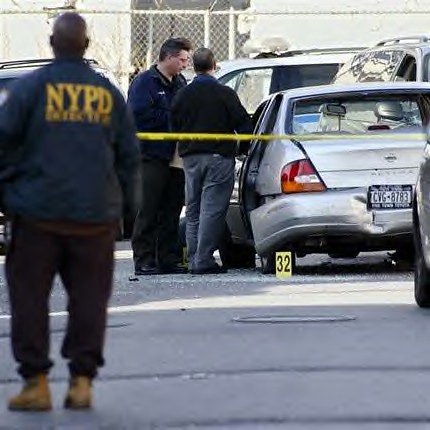
At that point Bell and his party walked back to their car and were shot by the detectives when the boys in blue apparently saw a passenger in the car reaching for a gun through the blackness of the pre-dawn hours and opened fire with 50 rounds, killing Bell and injuring his two passengers.

This caused outrage among New York City's population, as it brought back memories of the not-so-distant past of the NYPD and its murder of Amadou Diallo and the torture of Abner Louima. Now three of the five officers have been indicted for the crime that was committed and two of them face up to 25 years in prison.

However, reading the BBC news article I noticed something seemed awry. Detective Gescard Isnora, who, according to the article, fired the first shot, pulled his trigger 11 times and is charged with manslaughter and assault. Detective Michael Oliver discharged his weapon 31 times during the incident, which meant that he had to reload in the middle of his trigger-happy episode and empty a second clip and is also charged with manslaughter and assault. So the total between these two cops alone is 42.

The third man charged, Detective Marc Cooper, shot his weapon 4 times, which brings the total to 46 shots. That means that two detectives have gotten away with shooting 4 rounds at the unarmed men. There is no way to know whose bullets killed Sean Bell and injured his two friends. Sure, statistically Isnora and Oliver most likely shot the deadly bullets, but last time I checked the court requires proof beyond a reasonable doubt.

In order to make sure that Sean Bell's murderer sees justice, all of the police officers who discharged their weapons should be charged with murder, because if there were three civilians on a scene who shot at a person who died, I cannot imagine that the DA and a grand jury would pick and choose who to charge.