Showing posts with label democracy. Show all posts

Thursday, February 21, 2013

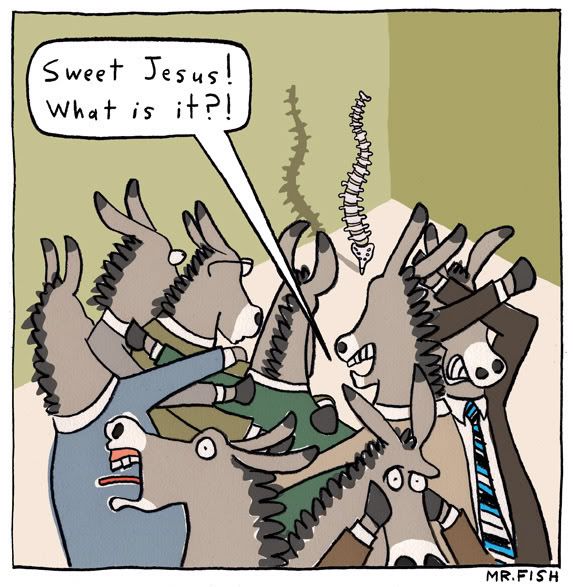
How to Fix The Republican Party in One Step

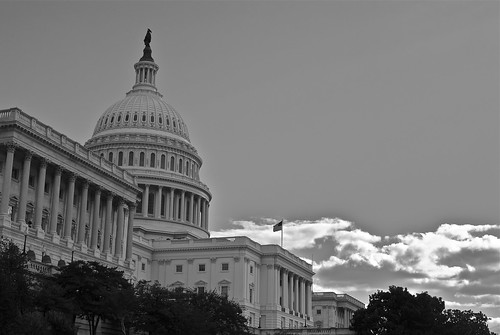
The United States Capitol (Flickr/Dray-Dray)
One of the major setbacks of the Democratic Party is that it is a big tent party; too many factions within the party. Looking back at the health care debate it is glaringly obvious that while it can be great to have a supermajority on paper, practically it may not work out as well as perceived. The Blue Dog Democrats immediately come to mind when thinking about internal strife within the party.

This has been the 21st century Democrat's problem: lack of party unity. It's not necessarily the Democratic Party's fault, because in order to have such a large party that aims to be as inclusive as possible you're bound to have some intraparty disagreements. When you have an opponent in George Bush (read: Dick Cheney and Karl Rove) who is able to keep their party in lockstep, convincing the nation to go to war with a country we had no business warring with while eroding civil liberties in the name of safety, it is going to be very difficult to rally any party together to fight it, especially the Democrats. But in 2008 the Dems did just that and then blew it as only the Democrats can.

But they've been handed a bit of luck, as the pre-2006 Republican Party simply does not exist. It is plagued by the infighting that doomed Obama's domestic legislative agenda from 2008-2010. The fact that the two of the past three State of the Union addresses had two Republican responses, one official and the other unsanctioned, is evidence of that on a macro level. The drama around the Boehner speaker vote can point to this on a micro level. Simply put, the Republican party is in crisis.

The worst part of the whole thing for Republicans is that now is the time to reinvent the party, but instead of coming up with a more dynamic platform to speak to the younger generation disillusioned by Obama's Bush-esque foreign policy and drama-filled presidency (whether he is to blame for the latter is another question), they move further to the right. Their 2012 candidates were embarrassing. They chose to put forth Mitt Romney, one of the most boring and out of touch individuals in recent history (honestly, I'd probably rather have a drink with Al Gore, which is saying a lot) and Paul Ryan, who got smoked by a much-ridiculed and jokey VP Biden in an embarrassing debate. Throw in your fringe candidates who were not distanced enough from the party (Richard Murdouck, Todd Akin) and you're bound to lose favor with the nation, even self-described Republicans. We're starting to see this occur.

Here's what the Republican Party needs to do: drop the culture war and stop with the self-victimization over social issues. Obama is not a Marxist, gay marriage will not ruin yours, and as much as it may pain the Republican Party to hear it, separation of church and state is a major part of this country's founding. Until the GOP realizes this, there will be no groundswell movement of young, disillusioned voters to their side of the aisle. Until Rush Limbaugh and Fox News talking heads no longer hold so much power in the party, masses of young people will steer clear from the GOP.

There can be two ways for the current dual-party system to go. One of the parties can adapt and bring in a fed up, young generation of voters and dominate until at least 2020. Or a new party can emerge - maybe a coalition of liberal Republicans and conservative Democrats (again, as long as they're not overly focused on some made up culture war) who feel their parties are missing out on a huge opportunity for votes (and they'd be right). If the two parties increase the polarization we've seen in Washington, Juan Linz may have to update his famous piece on presidential democracy. Let's hope we don't get to that point.

Correction 22 February 2013: A previous version of this post said that VP Biden smoked Ron Paul in a debate, when in reality it was Paul Ryan who was embarrassed that night.

Saturday, July 24, 2010

U.S. Senate Exhibits Pivotal Failure of Democracy

I've been writing about climate change issues for a while now. I've talked about the climate science, the leadership role of the House of Representatives, the childish politics and conservative propaganda. I've talked about the strong obstructionism against action by lobbyists, Republicans, and conservative Democrats. I've talked about the climatic, humanitarian, and security implications of inaction, and the concerted move (and failure) to block any government action at all. I've talked about the awareness among Americans, the problems with the media, and the implications of the oil spill.

But now it kind of feels like it's all over. Not because the Senate followed the House's leadership and passed a piece of climate change legislation of their own. But because the Senate fundamentally failed to do anything at all.

Thursday, January 21, 2010

Disaster in Massachusetts and a Supreme Court Decision that Disgraces Democracy

Two pieces of calamitous news in two days. Both pretty much impossible to swallow, but both realities moving forward.

The Massachusetts Senate Election

On Tuesday, Massachusetts voters elected the little-known Scott Brown to assume the late Ted Kennedy's seat. Kennedy spent decades fighting tooth and nail for health care reform, and now reform is severely threatened by Brown's impending inauguration. He has already vowed to obstruct the Democrats from passing a bill (nothing new for a Republican), and now Democrats are starting to back off any ambition they once had for making the bill strong and thorough. Massachusetts voters, who had been enamored of Ted Kennedy for decades, voted to betray his dying wish. I am not saying that the successor to his seat should have espoused his every view; I am saying that whatever values Ted Kennedy held that Massachusetts citizens ostensibly held in such high esteem for so long, they instantaneously turned their backs on.

There are innumerable factors that likely lifted Brown to victory, most of which have been discussed at length. Coakley ran an awful campaign. Voters were still disillusioned by the nation's employment and housing crises. The election was taken for granted by Democrats for too long. But whatever the reason for the shocking defeat, there are now 41 Republicans in the Senate, opening the possibility of interminable filibusters and continued obstruction until November, when Republicans will point out to Americans that Democrats have accomplished next to nothing, despite holding the Presidency and both Houses of Congress by sizable majorities.

The House climate bill can be completely scrapped. (Why do we even have a House, by the way? Sure, they're much more representative of our country than the Senate, but who needs representatives, when they don't seem to have a say in anything?) The relatively progressive House health care bill will likely give way entirely to the Senate health care bill so that at least something is passed (if there's no health care bill passed at all this year, Democrats can probably say goodbye to legislative chamber majorities come November). Who knows if there will be a jobs bill (even though that's what people are most concerned about right now). Financial regulations will pass, but likely in a weak bill that will maintain much of the status quo for the very sharks who helped push the world economy into a deep recession.

What exactly were Massachusetts voters voting for, then? Were they trying to send a message that they're mad? Because like it or not, Scott Brown will not get back at Wall Street. Scott Brown will not help create short-term jobs (his solution is to cut taxes). And by the way, when you're out of a job, Scott Brown certainly won't help you get health insurance. Oh, unless you're from Massachusetts, where progressive Democrats already passed legislation to ensure that for you. Ted Kennedy's dream, and life's work, which was so close to fruition, has been betrayed by his own loving constituents, solely because of his death. The irony is excruciating.

The U.S. Supreme Court Decision

In other horrible elections news, today the Supreme Court ruled that the government can't ban political spending by corporations in candidate elections. I've talked at length about this issue before. While I have problems with the inherent idea of democracy (see: Massachusetts voters voting against their own interests and the interests of their country), I still acknowledge that it is the only form of government that reflects the ideals of human freedom, justice, and equality. It has its flaws, of course, and must be periodically improved so that these core tenets are not betrayed. Today, they were betrayed.

The four conservative ideologues on the Supreme Court and one alleged (but woefully misguided) moderate have further opened the election process to unprecedented levels of cash injections from big businesses, arguing that they are defending the first amendment's guarantee of freedom of speech.

Let me first say that money is not speech, and conflating those two concepts is nefariously deceptive. But we have to remember here that the Constitution has been bent, twisted, and adulterated incessantly over the past 200+ years, to behoove whomever was "interpreting" its words. In this case, conservative judges who maintain Republican allegiances and were all appointed by Republican presidents, ruled against a bipartisan law that was designed to make elections fair and unbiased, untainted by the influx of money from self-interested groups corporations.

What is democracy now? Does the prefix demo- not mean "people"? What the majority of the Court failed to acknowledge was the underlying foundation of our democratic republic: the right of the people to choose their leaders, and the right for any person to have a chance to become one of those leaders, assuming they can compel the electorate to afford them enough votes. Now corporations will hold undue influence in all federal elections, the wealthiest of them having the biggest say in which politicians will be elected (think: Walmarts who exploit employees, Exxon Mobils and Southern Companies who unabashedly contribute to climate change, Pfizers and Aetnas who exploit the sick for massive profits, and Citigroups who get away with inciting economic turmoil and run away with unfathomable bonuses).

Whatever politicians who are still around that you thought were truly serving the interests of their constituents--that average "Joe the Plummer" that Republicans just love evoking--will soon be a vestige of a previous era of American politics. Don't get me wrong: Democrats are often just as guilty as Republicans when it comes to being beholden to special interests. And elected progressive Democrats who want to reform our election system to make it fair and democratic will soon be few and far between. Unbridled capitalism has commandeered our democracy. Our election system, the basis of American idealism, is truly tarnished in an irrevocable way (unless today's atrocious ruling is one day revoked).

It's been a really bad week for America.

Images: Scott Brown (New York Times), spineless Democrats (photobucket.com), Supreme Court Justices (Zimbio.com), Guy with sign (scu.edu)

Sunday, July 26, 2009

The Problems with Democracy II

In my last post I focused on the problems with American democracy from the constituency angle, namely the long-term-vision shortcomings of the American voter and how the inherent necessity of representatives to represent these voters often precludes sound, sustainable public policy. But there’s another, arguably more important, facet of the problematic tendencies of our democracy. And that, ironically, is that the American voter doesn’t have enough say in the process. At least, relative to the sway that well-financed organizations and companies can hold.

It seems that politicians are much more interested in the concerns of special interest groups than with those of their own constituents. Why is it that the largest corporations and trade associations in this country have so much power over the way Congress votes? I completely appreciate that these companies are, in many ways, vital to the American economy. They provide large shares of our GDP and employ many of our citizens. But the Constitution—for good reason—charges elected representatives to represent the people, not the private sector. Often, the interests of profit-maximizing corporations directly oppose the public interest. But the voice of the public interest pales in comparison to those of special interests, or at least it falls upon all-too-deaf ears.

Ordinary Americans don’t have the time or resources to be able to share their concerns with their elected officials the way paid professionals do. And when there’s a sizable number of largely poor people who aren’t having basic needs met (e.g. health care), you can bet they won’t be paying a lobbyist to show up in the halls of Congress and ask for a public option in health care reform. In too many cases, people whose needs are not being met are forced to rely on nonprofit organizations that are funded by wealthy idealists, and the genuine morality and conscience of politicians (for those select few who still retain these rare attributes).

But that’s really not good enough. Corporations should have a voice in Congress, but only to the extent that their dealings help the national economy and help keep people working. Unfortunately, much more powerful factors are also at work that shouldn’t be. The whole concept of campaign contributions has completely reshaped our democracy. There have been many laws put forth, and several passed, by those "moral" politicians mentioned above, which seek to reform campaign financing, but they are few and far between, and do not address the some of most pressing of the problems.

Why is the corn industry so heavily subsidized when those subsidies serve to hurt small farms, impoverish farmers in other countries, and make our food substantially less healthful? Why is the health insurance industry making such huge profits while dozens of millions of people are without health insurance? Why are utilities still permitted to build coal power plants, pollute our atmosphere, and heat our planet?

Money from organizations and corporations given to political campaigns needs to be dramatically curbed if we want any hope of giving the people a true voice in this country. And in the meantime, let's see to it that there's a great deal more transparency with regard to special interest group visits to Congressional offices, and other aspects of the political process infiltrated by special interests. The political process should have absolutely nothing to do with money. It should be reserved for those who, rich or poor, feel a genuine desire to serve their country. And that means enacting laws that benefit the citizens of this country, not the wealthiest and loudest interest groups.

Images: health care rally (Nashville scene blog), special interests (LiveTheSolution.com), money barrow (NorCal blogs)

Friday, July 10, 2009

The Problems with Democracy I

A new study by the Pew Research Center shows that there is a vast disconnect between the views of American scientists and the American public. Only about half of the public agrees that climate change is caused by humans, and 11 percent believes climate change doesn't exist at all. About one third of Americans believe there is still an ongoing debate on the subject. Meanwhile, nearly all scientists believe that human activity is directly related to climate change.

Many in the scientific community acknowledge that they have not done enough, and scientists in general do not do enough, to actively engage the public with regard to their research and findings. The media also deserves some blame for focusing too much on "both sides" of issues, instead of on objective expertise. But ultimately, scientists tend not to have any more say in public policy than anyone else, and in many cases, are largely overlooked or ignored.

The notion of American democracy is predicated upon the will of the people. And though it is not always the people who in fact have their will carried out (I'll touch on this in a later post), it is clear that the will of the people—the laypeople, if you will—is not necessarily the most logical, utilitarian, or even remotely beneficial drive for public policy. Indeed, the average person is caught up in their own narrow context within society (How much money will this cost me? How does this benefit me? Why should I care?).

One of the biggest selling points for conservatism is its championship of low taxes. And don't get me wrong; I don't like paying taxes either, and I happen to think there is a huge amount of government spending that is unnecessary, wasteful, and even harmful. But many Republican politicians capitalize on Americans' general attitudes by justifying our seemingly innate selfishness with their tirades against spending—even on programs that will ultimately serve to benefit far more people in the long run (e.g. universal health care).

Americans don't want to be taxed and don't want to have our money taken away. Americans don't want "government standing between you and your doctor," and don't want to have to pay more for the energy we consume. And so it makes sense that politicians exploit these widespread aversions. But this black and white idea of government staying out of our business and leaving us and our money alone simply doesn't make sense. In a world where no perfect market exists, it is government's responsibility to protect consumers, provide people with basic services that everyone should be entitled to (education, health care, public safety, etc.), and address negative externalities that affect citizens who would otherwise not be able to defend themselves.

When people are thinking strictly about their wallets—in part because politicians and the media are only fanning the flames of citizens' all-too-narrow perspectives of public policy—it serves to undermine the well being of society as a whole. Americans too often don't possess the wherewithal to make sound judgments about what policies would be best for them and the country as whole, especially in the long run.

And this doesn't even account for the increasingly frightening reality that people outside of the US are greatly affected by our activities. In the case of climate change, the people who are most vulnerable to losing their livelihoods, largely because of our country's exorbitant consumption habits, have absolutely no voice—within the context of our narrow Westphalian nation-state democracy—to be able to enact or even influence any changes.

The idea of the "perfection" of republican democracy is still hotly debated. People with no expertise or far-reaching knowledge about most subjects elect representatives—often for reasons that have little or nothing to do with policy initiatives—who are meant to serve the needs and wants of their constituents (and often exploit constituents' fears and selfish tendencies to maintain their own power). Policymakers and their advisers are too often far disconnected from the scientific community, and see no political advantage to seeking expert advice. Meanwhile, their policies can affect Americans and non-Americans alike who are unable to influence the political process at all. Modern democracy has serious flaws that continue to go unaddressed today.

Then again, as Winston Churchill once said, "Democracy is the worst form of government, except all the others that have been tried." Benevolent dictatorship, anyone?

Images: Statue of Liberty (wayfaring.info), taxes (justinperry.net), Julius Caesar (tqnyc.org)